Tianqiong Sensor IOT Technology Co., Ltd
Sales Manager:Ms. Emily Wang
Cel,Whatsapp,Wechat:+86 15898932201
Email:info@fengtutec.com
Add:No. 155 Optoelectronic Industry Accelerator, Gaoxin District, Weifang, Shandong, China


Sales Manager:Ms. Emily Wang
Cel,Whatsapp,Wechat:+86 15898932201
Email:info@fengtutec.com
Add:No. 155 Optoelectronic Industry Accelerator, Gaoxin District, Weifang, Shandong, China
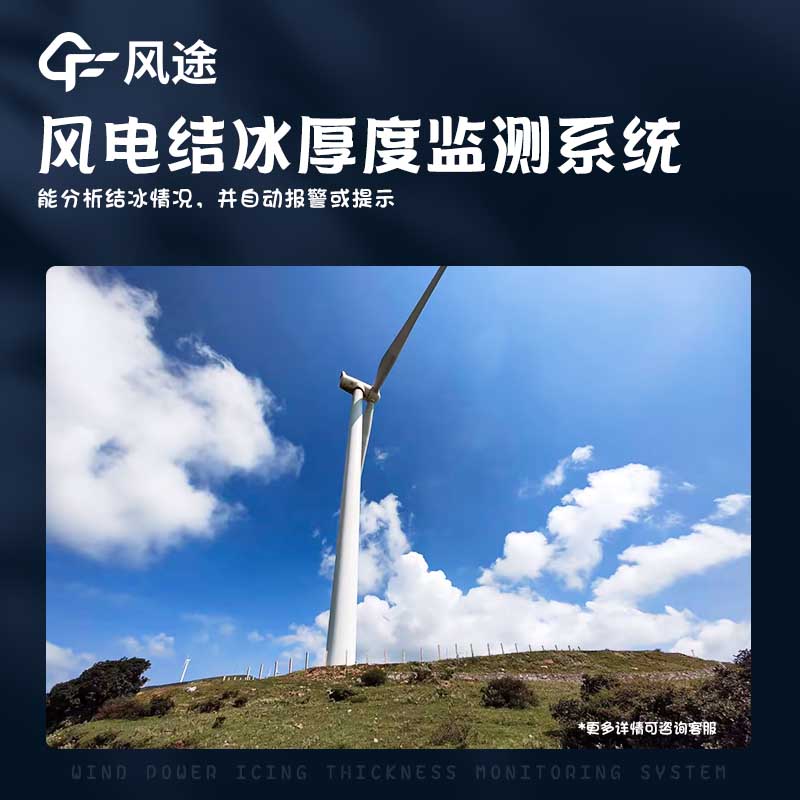
Model:FT-FDJB1
Brand:tianqiong
1.Wind power icing thickness monitoring system composition
Wind power icing thickness monitoring system can make precise and accurate measurements of ice thickness and monitor icing-related meteorological elements.
1.7 icing thickness sensors
Three sets of fan blades, each set of fan blades is equipped with two icing thickness sensors FT-JB3H, 6 subtotal
The main tower is equipped with an icing thickness sensor FT-JB1H
2.A micro meteorological instrument, monitoring elements wind speed, wind direction, temperature, humidity, atmospheric pressure, optical rainfall, total radiation
3.One set of hosts, collect and transmit data
4.A set of solar power supply systems
2.Wind power icing thickness monitoring system product features
1.Able to monitor the thickness of fan blades in real time, wind speed, direction, temperature, humidity, atmospheric pressure, optical rainfall and total radiation around the wind turbine, and automatically store and upload data to the backend;
2.Able to analyze the icing situation and automatically alarm or prompt;
3.Wind power icing thickness monitoring system technical parameters
1.Ice thickness: measurement principle microwave detection, maximum measurement thickness: 30.00mm, detection resolution: 0.01mm; power: <1W (optional ice melting device 15W)
2.Wind speed: measurement principle ultrasonic wave, 0~60m/s (±0.1m/s) resolution 0.01m/s; (Invention patent, Patent No.ZL 2021 1 0237536.5)
3.Wind direction: measurement principle ultrasonic wave, 0~360° (±2°); resolution: 1°; (Invention patent, patent number ZL 2021 1 0237536.5)
4.Air temperature: measurement principle diode junction voltage method, -40-60℃ (±0.3℃), resolution 0.01℃; (Beijing Meteorological Bureau calibration certificate)
5.Air humidity: measurement principle capacitive type, 0-100%RH (±3%RH), resolution: 0.1%RH; (Calibration certificate of Beijing Meteorological Bureau)
6.Atmospheric pressure: measurement principle piezoresistive type, 30-1100hpa (±0.25%), resolution 0.1hpa; (Calibration certificate of Beijing Meteorological Bureau)
7.Optical rainfall: measurement principle photoelectric, 0-4mm/min (≤±4%), resolution 0.01mm; (Invention patent, Patent number ZL 2022 1 1306149.3)
8.Total radiation: measurement principle photoelectric effect, 0-1800W/㎡ (<±3%), resolution 1W/㎡;
9.Collector power supply interface: GX-12-3P plug, input voltage 5V, with RS232 output Json data format, collector power supply: DC5V±0.5V peak current 1A,
10.Sensor modbus, 485 interface: GX-12-4P plug, output power supply voltage 12V/1A, device configuration interface: GX-12-4P plug, input voltage 5V
11.Solar power supply and equipped with lead-acid battery, optional 30W 20AH/50W 40AH/100W 100AH.Charging controller: 150W, MPPT automatic power point tracking, efficiency is increased by 20%
12.Data upload interval: 1 minute-1000 minutes adjustable
The handheld weather apparatus is a lightweight, portable meteorological observation device. Relying on precision sensors and intelligent chips, it accurately collects more than ten meteorological elements, supports GNSS positioning, long-term data storage, and 4G cloud data transmission, and...
These portable anemometers are easy to operate, equipped with precision sensors to measure wind speed, direction, and average wind speed. An internal storage chip stores long-term monitoring data, making them suitable for field meteorological monitoring across various industries....
Our self-developed Portable Weather Station breaks through the scenario limitations of traditional meteorological equipment. With multi-dimensional monitoring capabilities and high-precision performance, it has become the preferred equipment for various mobile monitoring scenarios.The device can sim...
The Ultrasonic Wind Speed Direction Sensor achieves measurement based on the characteristics of ultrasonic waves propagating in the air. It accurately calculates the wind speed and direction by measuring the time difference of ultrasonic waves propagating in different directions. This non-mechanical...


 Get a Free Quote
 Skype
Skype
 whatsapp
 mail
mail