Tianqiong Sensor IOT Technology Co., Ltd
Sales Manager:Ms. Emily Wang
Cel,Whatsapp,Wechat:+86 15898932201
Email:info@fengtutec.com
Add:No. 155 Optoelectronic Industry Accelerator, Gaoxin District, Weifang, Shandong, China


Sales Manager:Ms. Emily Wang
Cel,Whatsapp,Wechat:+86 15898932201
Email:info@fengtutec.com
Add:No. 155 Optoelectronic Industry Accelerator, Gaoxin District, Weifang, Shandong, China
time:2026-03-16 13:39:27 source:Weather Station viewed:357 time
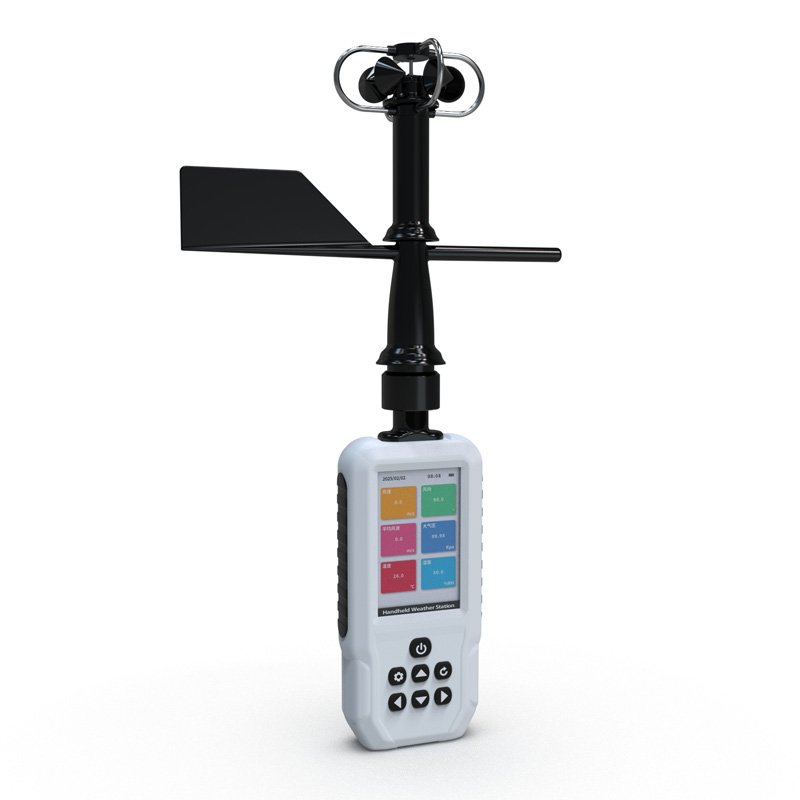
The electronic weather meter is a portable meteorological observation instrument that integrates the measurement of multiple weather parameters into a single unit. It is capable of simultaneously and accurately measuring factors such as wind speed, wind direction, average wind speed, temperature, humidity, atmospheric pressure, altitude, and heat index. This device supports real-time monitoring, data storage, and weather forecasting; it can be operated handheld or deployed using an optional tripod stand. Designed to adapt to complex outdoor terrains, it effectively meets the meteorological observation needs of field operations, outdoor sports, and on-site surveys.
Essentially a portable, multi-parameter meteorological observation device, the electronic weather meter consolidates the functionality of traditional fixed weather stations into a compact, handheld terminal. Utilizing built-in sensors and data processors, the instrument accurately measures various parameters—including wind speed, wind direction, average wind speed, temperature, humidity, atmospheric pressure, altitude, and heat index—while enabling real-time display, data logging, and trend analysis. The device can be operated by hand or mounted on an optional tripod for fixed deployment, allowing it to adapt to diverse outdoor environments such as mountains, river valleys, and coastal areas, thereby providing essential on-site meteorological data support for field personnel.
For wind speed and direction measurements, electronic weather meters typically employ either ultrasonic or impeller-type sensors. Ultrasonic sensors calculate wind speed and direction by measuring the time difference of sound waves propagating through the air; lacking mechanical moving parts, they offer rapid response times and are well-suited for long-term monitoring. Impeller-type sensors, conversely, feature a simple structure and a low start-up wind speed threshold, making them ideal for quick, on-site measurements. The instrument displays instantaneous wind speed, maximum wind speed, average wind speed, and the corresponding wind direction angle; select models also feature a "wind rose" display function to assist users in identifying and analyzing airflow patterns.
The altitude measurement function operates based on the correlation between atmospheric pressure and elevation. By applying built-in algorithms, the device calculates altitude in real-time with an accuracy typically within 3 to 5 meters, making it a valuable tool for tracking elevation data during mountaineering, hiking, and field surveys. The heat index function synthesizes temperature and humidity data to calculate the "feels-like" temperature and assess heat stress levels—including metrics such as the Temperature-Humidity Index (THW) and the standard Heat Index—thereby providing a crucial reference for heat prevention and cooling strategies during outdoor operations. In terms of data storage and transmission, the electronic weather meter features a built-in memory chip capable of continuously recording anywhere from thousands to tens of thousands of historical data sets, with each record containing a complete set of multi-parameter measurements and a corresponding timestamp. Users can export this data to a mobile app or computer software via Bluetooth, USB, or a wireless module to generate trend charts and statistical reports. Certain models also support connectivity with mobile devices, enabling real-time remote data transmission and location tagging.
Electronic weather meters find widespread application in fields such as meteorological observation, outdoor sports, agricultural production, and engineering construction. Weather enthusiasts can use them to track localized weather fluctuations. Hikers and mountaineers can monitor environmental conditions in real-time to assess travel risks. Agricultural technicians can measure environmental parameters relevant to crop growth directly in the field. On construction sites, these devices can be utilized to monitor wind speeds for safety during high-altitude operations. Furthermore, in scenarios involving field surveys, geological exploration, and environmental monitoring, this device facilitates the rapid acquisition of on-site meteorological data.
The housing of the electronic weather meter is typically constructed from engineering plastics or aluminum alloy, boasting an ingress protection (IP) rating of IP54 or higher, which provides effective resistance against dust and splashing water. The display screen utilizes high-contrast LCD or OLED panels, ensuring clear readability even under bright lighting conditions. Power is typically supplied by a built-in rechargeable lithium battery or standard dry cells, offering a continuous operating time of up to several tens of hours. The device's overall weight is kept within a range of 200 to 500 grams, making it highly portable and easy to operate with a single hand.
Agricultural Weather Stations,Customizable Parameters and Intelligent Monitoring as Key Tools for Scientific Decision-making in AgricultureAgricultural Weather Stations enable free customization of parameters and intelligent monitoring, serving as vital tools for scientific decision-making in agricu...
The portable weather station is an integrated, low-power, high-precision automatic observation device. It supports multiple transmission modes, can be quickly deployed, and can monitor twelve types of meteorological and environmental elements in real time. It is suitable for monitoring operati...
Fluorescent Quantitative PCR Detection System supports simultaneous four-color fluorescence detection and parallel analysis of 32 samples, suitable for pathogen detection, gene expression analysis, food safety monitoring, and disease control in aquaculture. Fluorescent Quant...
Waste Water Quality Monitoring can detect water temperature, COD, ammonia nitrogen, pH, residual chlorine, dissolved oxygen, and other indicators online. The sensors are flexibly selectable, and it has data storage and export functions. Equipped with an RS485 interface, it can connect to vario...


 Skype
Skype
 whatsapp
 mail
mail