Tianqiong Sensor IOT Technology Co., Ltd
Sales Manager:Ms. Emily Wang
Cel,Whatsapp,Wechat:+86 15898932201
Email:info@fengtutec.com
Add:No. 155 Optoelectronic Industry Accelerator, Gaoxin District, Weifang, Shandong, China


Sales Manager:Ms. Emily Wang
Cel,Whatsapp,Wechat:+86 15898932201
Email:info@fengtutec.com
Add:No. 155 Optoelectronic Industry Accelerator, Gaoxin District, Weifang, Shandong, China
time:2025-07-16 08:50:39 source:Weather Station viewed:639 time
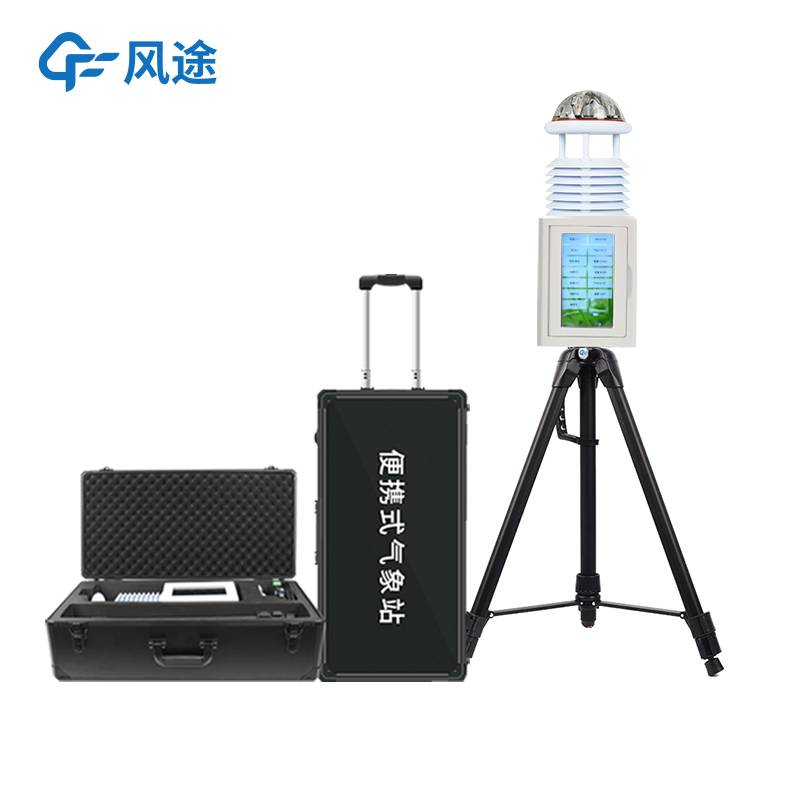
In daily meteorological monitoring, Tianqiong Technology's Portable Weather Station has become a reliable "meteorological monitoring expert" around people with its solid performance.
It boasts comprehensive monitoring capabilities. The device integrates a variety of high-precision sensors, capable of real-time measurement of basic meteorological data such as wind speed, wind direction, temperature, humidity, and air pressure. Many models can also detect PM2.5, PM10, and noise. For instance, the 8-in-1 model can collect surrounding meteorological and environmental information, providing users with complete data references applicable to various scenarios.
Its design takes practical usage needs into full consideration. The device is compact and lightweight, easy to hold and carry. It can be easily set up and put into operation whether in farmlands, parks, remote mountainous areas, or on marine research vessels. The sensor housing is made of imported ABS material, resistant to harsh environments like salt spray, with an IP65 protection rating. Even in extreme weather or complex climates, it can work stably, ensuring the accuracy of measured data.
Data transmission and viewing are also convenient. It supports wired, Bluetooth, GPRS, and other connection methods, allowing users to choose according to on-site conditions. The monitored data can be quickly transmitted to mobile phones, computers, or dedicated software. The main unit is equipped with a 7-inch LCD screen, enabling on-site staff to clearly view real-time data at a glance. Even when not on-site, users can check data changes and analyze historical records at any time in the office or at home through supporting software, facilitating decision-making.
It has a wide range of applications. Meteorological personnel use it for emergency observation and mobile monitoring, enabling them to quickly obtain meteorological data in specific areas, laying the foundation for weather forecasting and research. Farmers and agricultural technicians rely on it to monitor farmland meteorological conditions, determining when to water and fertilize, and taking early precautions against pests and diseases to ensure better crop growth. Forestry and environmental protection workers use it to monitor meteorological changes in forests and wetlands, providing data support for environmental protection. In water conservancy, measuring river water levels and rainfall can assist in water conservancy project construction and flood prevention. Even outdoor enthusiasts can use its meteorological information to plan routes during hiking, camping, and mountain climbing, ensuring safety.
Handheld anemometers measure wind speed and direction using the ultrasonic time-of-flight method. Multiple built-in ultrasonic probes calculate wind field data by measuring the time difference of sound wave propagation in the wind direction. The device has no moving mechanical parts, zero star...
Traditional weather stations often suffer from limitations such as complicated installation and fixed locations, making it difficult to meet the immediate data needs for on-site emergency weather events, field scientific research, or temporary activities. The FT-BQX6 Portable Weather Station was des...
FT-WQX7, All-in-One Weather SensorsThe top cover hidden ultrasonic probe with physical shielding structure can effectively prevent rain and snow from accumulating on the probe surface to interfere with signal transmission and reception, and reduce the turbulence effect caused by direct impact of nat...
The microclimate of farmland refers to the small-scale climatic environment formed by the interaction among the surface air layer, soil layer and crop population in the farmland. It is reflected by the values of agricultural meteorological elements such as radiation, air temperature and humidity, wi...


 Skype
Skype
 whatsapp
 mail
mail