Tianqiong Sensor IOT Technology Co., Ltd
Sales Manager:Ms. Emily Wang
Cel,Whatsapp,Wechat:+86 15898932201
Email:info@fengtutec.com
Add:No. 155 Optoelectronic Industry Accelerator, Gaoxin District, Weifang, Shandong, China


Sales Manager:Ms. Emily Wang
Cel,Whatsapp,Wechat:+86 15898932201
Email:info@fengtutec.com
Add:No. 155 Optoelectronic Industry Accelerator, Gaoxin District, Weifang, Shandong, China
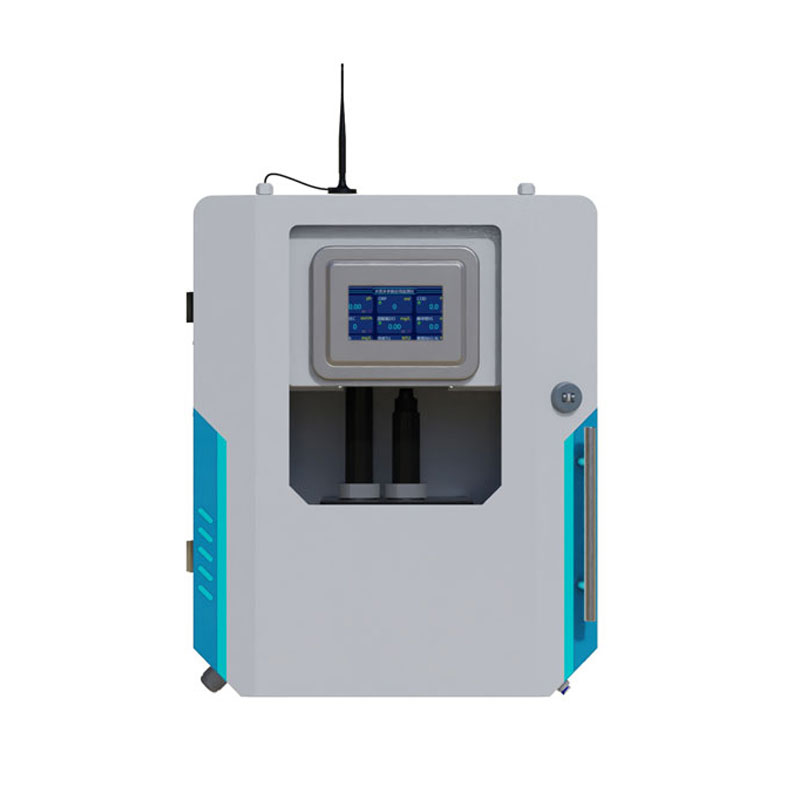
Model:FT-GSZ9
Brand:tianqiong
1、Online Turbidity Analyzer Product Introduction
Online Turbidity Analyzer is specifically designed to measure turbidity levels in filtered water, reuse water, raw water and many industrial wastewater treatment facilities.Online Turbidity Analyzer water quality monitoring system is a comprehensive sensor data collection, display, and historical curve monitoring system based on IoT technology.It consists of a flow stabilization and exhaust unit, an analysis and monitoring sensor unit, a system control unit, and a remote communication unit.It features comprehensive power supply, network communication, and real-time cloud-based data observation and analysis.
2、Online Turbidity Analyzer Applications
This device is designed for online water quality monitoring at water supply terminals with a pressure below 0.3 MPa.It can be widely used in urban and rural waterworks, water distribution networks, secondary water supply systems, user terminals, indoor swimming pools, large-scale water purification facilities, and direct drinking water.It is an essential online analyzer for water plant production process control, water conservancy, water management, and health supervision.
3、Online Turbidity Analyzer Functions and Features
1.4G GPRS networking.
2.Supports RJ45 network expansion.
3.Supports remote sensor transmission.
4.4.3-inch touchscreen display.
5.Supports 8GB of data storage and TF card data export.
6.Supports one RS485 Modbus-RTU slave.
7.Supports multiple RS485 Modbus-RTU sensor expansions.
8.Supports IoT data display, storage, and analysis platform.
9.The platform supports data forwarding through multiple protocols, including TCP short links and HTTP.
4、Online Turbidity Analyzer System Components
The water quality monitoring microsystem consists of a power supply unit, a sensor data monitoring unit, a display unit, a flow cell unit, a remote communication unit, and an integrated box main unit.
1.Power Supply Unit
Power Adapter: AC220 to DC12V/2A.
2.Analysis and Testing Unit
The analysis and testing unit is mainly composed of water temperature and turbidity sensors, which are fixed to the flow cell through threads or tight fitting fixtures.The main parameters of the sensors are as follows
| Serial number | Sensor type | Measurement range | Measurement principle | Measurement accuracy |
| 1 | Temperature | 0~85℃ | High precision digital sensor | ±0.1℃ |
| 2 | Turbidity | 0~1000NTU | Scattering light method | ±1% |
3、Integrated enclosure main unit
| Installation method | Rack-mounted on the wall with a matching hanging bracket. |
| Dimensions | 520X240X210mm (excluding external communication antenna) with antenna total height 800mm |
| Case material | 304 Stainless Steel. |
| Protection level | IP54 |
| Power supply | AC220V Internal Power Adaptor AC220 to DC12V/3A |
| Inlet | PE pipe of 2-point water purifier with an outer diameter of φ6.5, flow rate of 500 mL/min, and pressure of 0.1-0.2 MPa. |
| Outlet | PE pipe of 2-point water purifier with outer diameter φ6.5, flow rate 400 mL/min |
| Discharge outlet | PE pipe of 2-point water purifier with outer diameter φ6.5, flow rate 100 mL/min (manual regular drainage can also be done) |
Note: The sensor should not be installed upside down or horizontally.It should be installed at a minimum angle of 15 degrees.
The operating environment of the above water quality sensors is 0-50°C and <0.3 MPa.
The sensor can be configured to meet specific monitoring requirements.The above sensor parameters are only for reference.Please read the sensor manual for details.
Microclimate refers to the small - scale climatic characteristics of the near - surface atmosphere and the upper layer of soil, which are caused by the specific structural features of the underlying surface. These characteristics are usually reflected in individual meteorological values and sometime...
Ground-based fixed monitoring points are limited by their installation locations and can only reflect visibility conditions in specific areas, making it difficult to cover the airspace above vast or complex terrains. For example, in mountainous areas, canyons, coastal regions, etc., there may be dif...
Pool and Spa Water Quality Monitoring provides 24/7 online monitoring of core parameters including pool water temperature, pH, residual chlorine, turbidity, dissolved oxygen, and ORP. Data recording is accurate and traceable, supporting sensor expansion, data export, and alarms for exceeding l...
With the acceleration of urbanization and industrialization, regional and complex air pollution problems have become increasingly prominent. Traditional ambient air quality monitoring networks typically consist of a limited number of well-equipped national or provincial control stations. While these...


 Get a Free Quote
 Skype
Skype
 whatsapp
 mail
mail