Tianqiong Sensor IOT Technology Co., Ltd
Sales Manager:Ms. Emily Wang
Cel,Whatsapp,Wechat:+86 15898932201
Email:info@fengtutec.com
Add:No. 155 Optoelectronic Industry Accelerator, Gaoxin District, Weifang, Shandong, China


Sales Manager:Ms. Emily Wang
Cel,Whatsapp,Wechat:+86 15898932201
Email:info@fengtutec.com
Add:No. 155 Optoelectronic Industry Accelerator, Gaoxin District, Weifang, Shandong, China
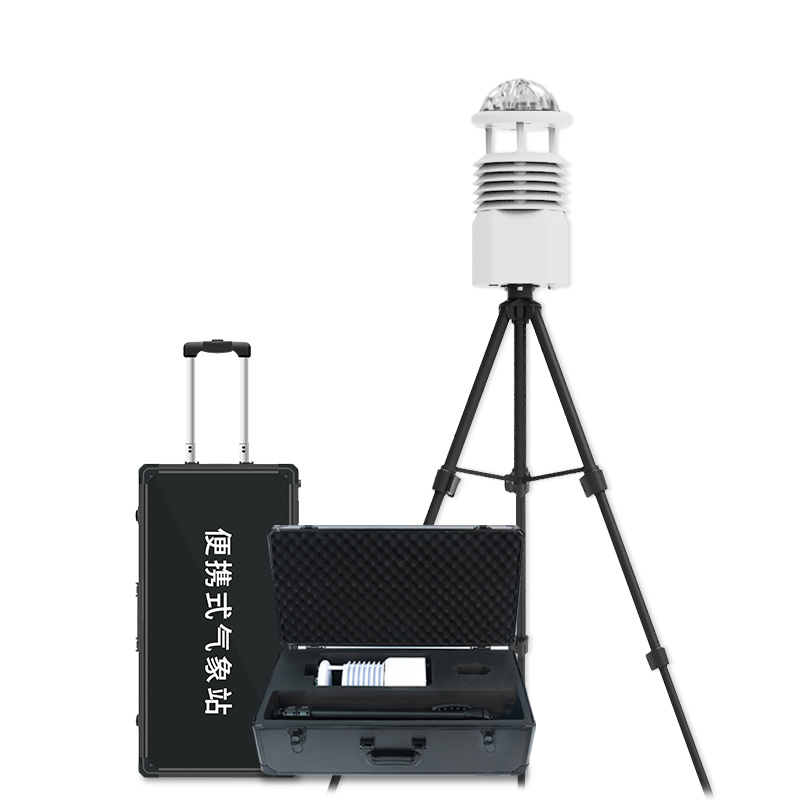
Model:FT-BQX6
Brand:tianqiong
1.Product introduction of Wireless Weather Station
Wireless Weather Station is an easy-to-install weather station perfect for personal or professional use that allows you to track weather phenomena such as rain, wind, temperature, and more.BQX6 Wireless Weather Station is a highly integrated, low-power, fast installation and easy for field monitoring.
The device supports wired, Bluetooth, GPRS and other transmission methods, is debug-free and can be quickly arranged.It is suitable for the acquisition of meteorological data such as short-term emergency meteorological observations and mobile meteorological monitoring.It is widely used in meteorology, agriculture and forestry, environmental protection, ocean, airport, port, scientific investigation, campus education and other fields.
The device adopts a six-element integrated sensor, which can conduct real-time observation of meteorological elements such as wind speed, wind direction, temperature, humidity, air pressure, optical rainfall, etc.The sensor shell is made of imported Stainless steel material, which is more effective in resisting salt spray and other environments, and has a protection level of IP65 or above.
2.Product features of Wireless Weather Station
1.The hidden ultrasonic probe on the roof cover can avoid interference from rain and snow accumulation, and avoid natural wind shading☆
2.The principle is to transmit a continuous frequency conversion ultrasonic signal, and to detect the wind speed and direction by measuring the relative phase☆
3.Integrated sensor with six elements: wind speed, wind direction, temperature, humidity, air pressure, and optical rainfall☆
4.Standard configuration: GPRS, Bluetooth, 485 to USB
5.Aluminum alloy bracket, retractable
6.Shock-absorbing protective trolley case, easy to carry
3.Technical parameters of Wireless Weather Station
1.Wind speed: measurement principle: ultrasonic wave, range: 0~60m/s, accuracy: 0.1m/s+0.01v, resolution: 0.1m/s;
2.Wind direction: measurement principle: ultrasonic wave, range: 0~360°, accuracy: ±2°, resolution: 1°;
3.Air temperature: measurement principle diode junction voltage method, range: -40-80℃, accuracy: ±0.3℃ (25℃), resolution: 0.01℃;
4.Air humidity: measurement principle capacitive type, range: 0-100%RH, accuracy: ±3%RH (20%~80%), resolution: 0.01%RH;
5.Atmospheric pressure: measurement principle piezoresistive type, range: 300-1100hpa, accuracy: ±0.25%, resolution: 0.1hpa;
6.Optical rainfall: range: 0-4mm/min, accuracy: ≤±4%, resolution: 0.01mm;
7.Data storage: no less than 500,000 pieces;
8.Power consumption: 1.5W
9.Lithium battery: capacity 12000maH, battery life ≥50h, battery capacity display function
10.Total weight of the equipment: ≤5kg;
11.Layout time: 1 person, no more than 2 minutes to complete the layout;
12.The manufacturer has ISO quality management system, environmental management system and occupational health management system certification
13.The manufacturer has a computer software registration certificate
14.The manufacturer is a 3A-level credit enterprise
4.Introduction to Wireless Weather Station computer software
1.Software for receiving, storing, viewing and analyzing PC stand-alone version of data
2.Support serial port data reception, processing and display
3.Support json strings, modbus485 and other communication methods
4.The storage time can be set by itself.The acquisition time can be set by itself in modbus485 acquisition mode
5.Support self-service addition, deletion, and modification of monitoring parameters protocols, names, icons, etc.
6.Support data post-processing function
7.Support external running of javascript scripts
5.Introduction to Wireless Weather Station Android APP
1.Android stand-alone version of data reception, storage, viewing and analysis software
2.Support Bluetooth data reception
3.The software background reception and processing after the mobile phone is dormant
4.Json data is automatically added to the device, modbus device supports scanning code to add the device
5.Support historical data viewing, analysis, and export tables, support curve display and single data point viewing
6.Support data post-processing function
7.Support external running of javascript scripts
6.Introduction to Wireless Weather Station Cloud Platform
1.CS architecture software platform, supports direct observation of mobile phones and PC browsers without additional software installation
2.Support multiple accounts and multiple devices to log in
3.Support real-time data display and historical data display dashboard
4.Cloud server and cloud data storage, stable and reliable, easy to expand, and load balanced
5.Support SMS alarm and threshold settings
6.Support map display and viewing device information.
7.Support data curve analysis
8.Support data export table form
9.Support data forwarding, HJ-212 protocol, TCP forwarding, http protocol, etc.
10.Support data post-processing function
11.Support external running of javascript scripts
Currently, the situation of urban atmospheric pollution is becoming increasingly complex, and traditional methods for monitoring atmospheric pollution sources are facing numerous challenges. The existing national control monitoring system for ambient air has problems such as a small number of monito...
The LED-display Small Weather Station is capable of monitoring negative oxygen ion concentration in the air around the clock and can expand monitoring items according to user needs, such as meteorological parameters like air temperature, air humidity, PM2.5, and PM10.Measurement Principles and Techn...
A fully automated online hydrological monitoring system, based on K-band planar radar microwave technology, can collect water level, flow velocity, flow rate, and rainfall data non-contactly. Adaptable to various hydrological scenarios, it is resistant to environmental interference, easy to op...
Traditional meteorological monitoring often relies on large, fixed national-level weather observation stations. While these stations provide extremely accurate data, they also suffer from high construction costs, low density, and limited coverage. With social development, our demand for meteorologic...


 Get a Free Quote


 Skype
 whatsapp
 mail