Tianqiong Sensor IOT Technology Co., Ltd
Sales Manager:Ms. Emily Wang
Cel,Whatsapp,Wechat:+86 15898932201
Email:info@fengtutec.com
Add:No. 155 Optoelectronic Industry Accelerator, Gaoxin District, Weifang, Shandong, China


Sales Manager:Ms. Emily Wang
Cel,Whatsapp,Wechat:+86 15898932201
Email:info@fengtutec.com
Add:No. 155 Optoelectronic Industry Accelerator, Gaoxin District, Weifang, Shandong, China
time:2025-03-06 10:13:08 source:Weather Station viewed:565 time
Two - dimensional ultrasonic anemometers can only measure two parameters: wind speed and direction on the horizontal plane. They cannot obtain information about the wind in the vertical direction, such as vertical wind speed or the upward/downward speed of vertical airflows. Therefore, they are only suitable for scenarios where the requirements for vertical wind speed are not high and the main focus is on horizontal wind conditions.
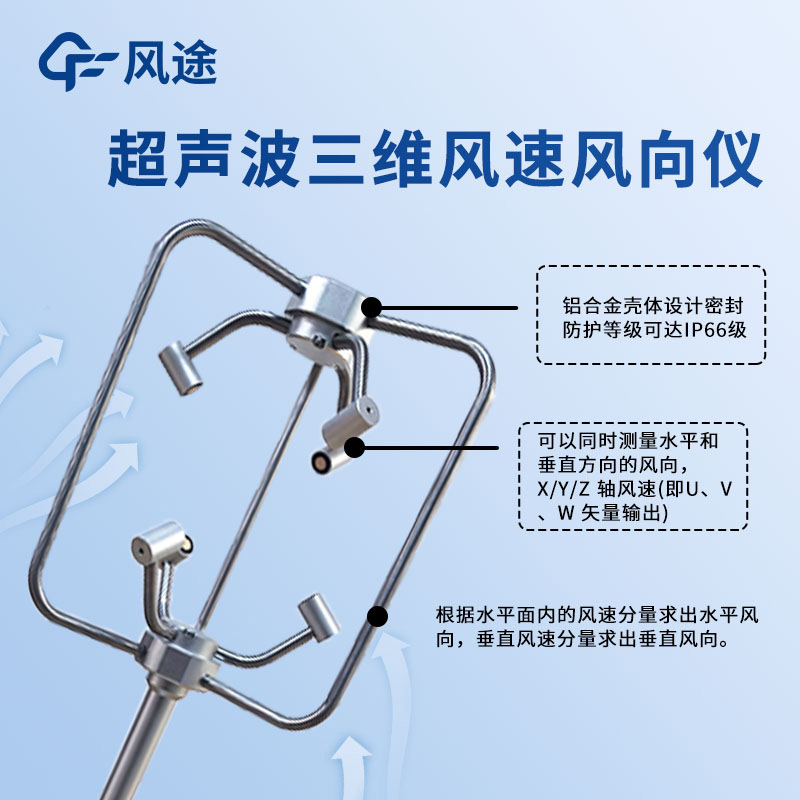
In situations where it is necessary to accurately understand the three - dimensional motion state of the wind, the commonly used anemometer is the 3D Ultrasonic Anemometer. It can simultaneously measure the wind speed components in three directions in three - dimensional space, usually represented by the x, y, and z axes. It can obtain complete vector information about the wind in both horizontal and vertical directions, including horizontal wind speed, horizontal wind direction, and vertical wind speed, providing a more comprehensive and realistic description of the wind field.
TianQiong offers three models of 3D Ultrasonic Anemometers, namely FT - SWF1, FT - SWF2, and FT - SWF3, each with its own advantages to meet the wind speed measurement needs in different scenarios.
The FT - SWF1 is equipped with a high - quality aluminum alloy housing. It has a compact and aesthetically pleasing structure, making it easy to install and maintain. It supports both 2D and 3D measurement modes. In the 2D mode, it can measure horizontal wind speed, vertical wind speed, wind direction, wind temperature, and sound speed. In the 3D mode, it can measure the wind speeds along the U, V, and W axes. It is suitable for applications such as wind power generation and meteorological monitoring of roads and bridges. Its wind speed measurement range is 0 - 60m/s with an accuracy of ±3%. The wind direction measurement range is 0 - 360°. The operating voltage is 9 - 36V, and the protection level is IP65.
The FT - SWF2 is made of stainless steel, which has strong environmental resistance. It features high - precision measurement, fast response, and high reliability. It is small in size, light in weight, with a reasonable and aesthetically pleasing appearance design, and is easy to install. It is widely used in fields such as meteorology, environmental protection, and energy, for example, air quality monitoring, meteorological disaster warning, building environment monitoring, and wind energy resource assessment. The wind speed measurement range is 0 - 70m/s with an accuracy of ±3%. The wind direction measurement range is 0 - 360° with an accuracy of ±2°. The measurement frequency is 1Hz. The operating voltage is 12V, and the protection level is IP65.
The FT - SWF3 utilizes ultrasonic measurement technology. Its unique structural design reduces wind resistance and improves measurement accuracy. It is made of all - metal materials and has no moving parts, so it is sturdy and durable. It can measure both horizontal and vertical wind speeds and is suitable for complex measurement environments. The wind speed measurement range is 0 - 70m/s with an accuracy of ±3%. The wind direction measurement range is 0 - 360°. The operating voltage is 12V, and the protection level is IP65.
The UAV visibility meter is designed with full consideration of the requirements for UAV mounting. It features a lightweight and compact design, enabling it to be easily adapted to various small UAV platforms and reducing the burden on the UAV during flight. At the same time, the flat body design ca...
Handheld Anemometer is a portable meteorological observation instrument that integrates the measurement of wind speed, wind direction, and average wind speed into a single unit. It features a wind speed measurement range of 0–60 m/s with an accuracy of ±0.3 m/s, and a wind direction range of...
The Portable Weather Station (7-inch Android Touchscreen) is a device specifically designed for various meteorological monitoring scenarios. With "portability and practicality" as its core design concept, it features a lightweight build and a foldable, telescopic structure. It requires no...
Integrating precision sensors and a smart chip, these portable anemometers can simultaneously measure wind speed, wind direction, and average wind speed with an accuracy of ±0.3 m/s and ±3°. The built-in high-capacity storage chip can store one year's worth of data, making it suitable f...


 Skype
Skype
 whatsapp
 mail
mail