Tianqiong Sensor IOT Technology Co., Ltd
Sales Manager:Ms. Emily Wang
Cel,Whatsapp,Wechat:+86 15898932201
Email:info@fengtutec.com
Add:No. 155 Optoelectronic Industry Accelerator, Gaoxin District, Weifang, Shandong, China


Sales Manager:Ms. Emily Wang
Cel,Whatsapp,Wechat:+86 15898932201
Email:info@fengtutec.com
Add:No. 155 Optoelectronic Industry Accelerator, Gaoxin District, Weifang, Shandong, China
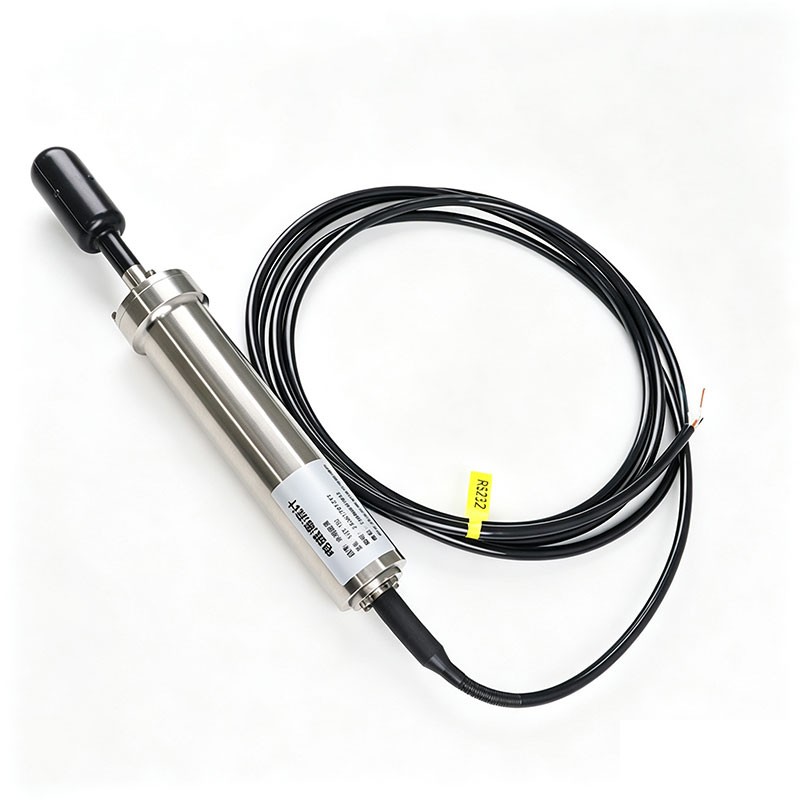
Model:FT-HL1
Brand:tianqiong
1、ocean current meter Product Introduction
ocean current meter is an ocean observation device that measures the speed and direction of ocean currents in real time.ocean current meter adopts a cable-operated design, applying Faraday's law of electromagnetic induction to measure ocean current parameters by measuring the induced electromotive force generated when seawater flows through a magnetic field.
It features a built-in electronic compass for accurate measurement of azimuth, pitch, and roll angles.
The outer shell is made of wear-resistant, impact-resistant, and corrosion-resistant titanium alloy, with a maximum operating depth of 1500 meters.
2、ocean current meter Equipment Parameters
Water Temperature: Thermistor temperature measurement; Range -3℃~45℃; Accuracy ±0.05℃; Resolution 0.001℃
Flow Velocity: Electromagnetic induction; Range 0~500cm/s; Accuracy ±1cm/s or ±2% of measured value; Resolution 0.1cm/s
Flow Direction: Azimuth current meter; Range 0~359.9°; Accuracy ±2°; Resolution 0.1°
Housing Material: Titanium Alloy
Dimensions: Φ50mm*365mm
Maximum Depth: 1500m
Protection Rating: IP68
Weight: 1kg
3、ocean current meter Product Dimensions
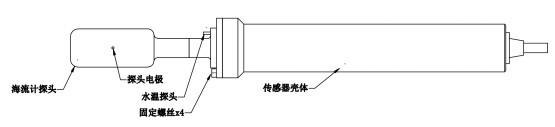
4、ocean current meter Precautions for Use
1. Do not touch the probe electrodes with bare hands, as this may damage the electrodes and affect measurement accuracy.
2. The current meter probe should be installed in the center of the measured water flow, and there should be no obstructions within a 30 cm radius around the probe; otherwise, normal measurement will be affected.
3. The current meter has a built-in magnetic compass that measures flow direction by sensing the Earth's magnetic field. When ferromagnetic materials are present around the magnetic compass, these materials will generate additional magnetic fields, which will superimpose with the Earth's magnetic field, thus changing the direction and intensity of the total magnetic field sensed by the compass, leading to errors in flow direction measurement and decreased measurement accuracy. Therefore, the current meter mounting bracket should be made of a material with weak magnetism (such as 316 stainless steel), and there should be no ferromagnetic materials within 1 meter of the current meter probe.
4. When the current meter is installed on a fixed platform, directly retrieve the flow velocity and direction data returned from the command. When the current meter is installed on a moving platform, the translational or rotational movement of the platform will cause deviations in the flow velocity and direction measured by the current meter. The collected flow velocity and direction data needs to be processed to eliminate the influence of platform movement on the flow velocity and direction measurement to obtain accurate flow velocity and direction data.
5. The device must be installed vertically; otherwise, measurement accuracy will be affected. The temperature probe of the current meter should be oriented due north. When the installation tilt angle is ≥10°, the built-in electronic compass output data will be distorted; when the installation tilt angle is ≥15°, the built-in electronic compass will stop outputting data, and the device will be in a stopped state.
6. Take care to prevent water damage when connecting or disconnecting the cable, otherwise it may damage the current meter.
7. When cleaning attached marine organisms, do not strike or hit the casing forcefully, especially the probe electrodes, as this may damage the current meter.
8. Do not continue to use the device if the casing is deformed or the cable is damaged.
The portable anemometer is a mobile intelligent observation device integrating multiple meteorological monitoring functions. Relying on precision sensors and intelligent chips, it achieves accurate measurement of multiple elements, supports long-term data storage and convenient data transmissi...
A School Weather Station is a comprehensive device established on campus that can automatically, continuously, and in real-time observe and record various meteorological elements. Composed of sensors, data loggers, power supply systems, communication modules, and data display platforms (such as camp...
Air quality monitoring stations are compact in size and occupy a small footprint, making them easy to install and deploy. They can be flexibly set up in various locations, such as urban streets, parks, schools, communities, and industrial parks, and even installed on external walls of buildings or s...
In the road traffic environment safety monitoring system, the Laser Snow Depth Monitor, especially in areas with frequent snowfall in winter, can accurately and real-time monitor the depth of snow on the road surface. It provides key data for traffic management departments, helping to ensure road sa...


 Get a Free Quote
 Skype
Skype
 whatsapp
 mail
mail