Tianqiong Sensor IOT Technology Co., Ltd
Sales Manager:Ms. Emily Wang
Cel,Whatsapp,Wechat:+86 15898932201
Email:info@fengtutec.com
Add:No. 155 Optoelectronic Industry Accelerator, Gaoxin District, Weifang, Shandong, China


Sales Manager:Ms. Emily Wang
Cel,Whatsapp,Wechat:+86 15898932201
Email:info@fengtutec.com
Add:No. 155 Optoelectronic Industry Accelerator, Gaoxin District, Weifang, Shandong, China
time:2026-09-17 11:05:45 source:Weather Station viewed:1 time
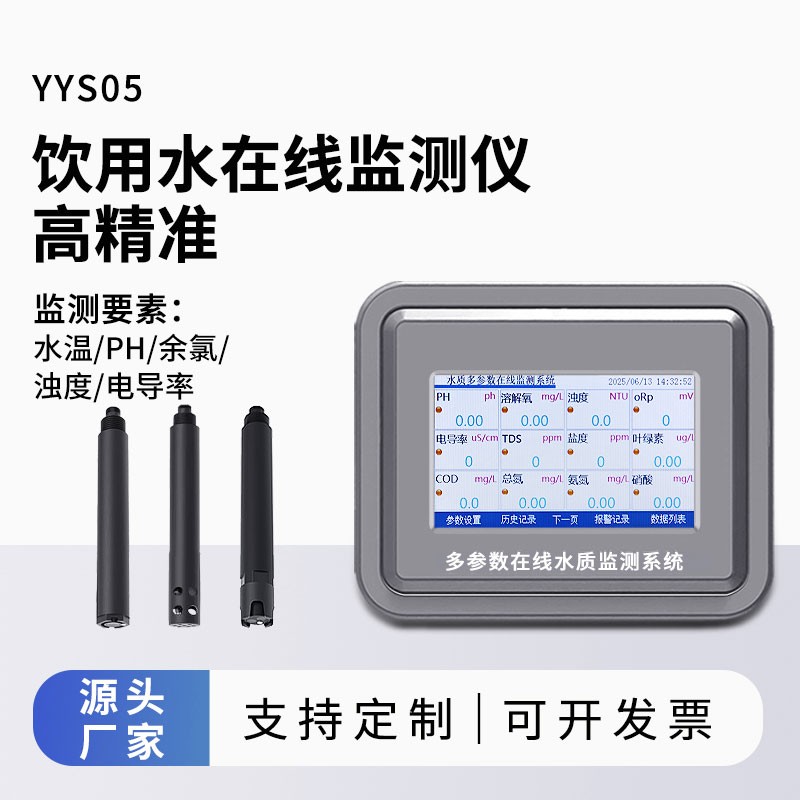
Drinking water monitoring system enables real-time, precise detection of key water quality parameters such as residual chlorine, pH, and turbidity. It supports sensor expansion and data export, utilizes standardized industrial communication to interface with various devices, and is suitable for routine water quality monitoring across diverse applications.
Drinking water monitoring system is an intelligent monitoring device designed for water quality management across various water bodies. It primarily captures key parameters—including residual chlorine, pH, turbidity, conductivity, and water temperature—in real-time and with high precision. Replacing traditional manual sampling and testing methods, it enables automated and routine water quality monitoring. The device reliably records real-time data, historical data, and anomaly alerts, while supporting data export and traceability, thereby providing accurate, valid data to support water quality control, process adjustments, and compliance testing.
Drinking water monitoring system features excellent scalability through a modular sensor design; monitoring probes can be freely combined and independently replaced, supporting plug-and-play functionality. Personnel can flexibly select sensors based on specific monitoring scenarios—adding parameters such as ammonia nitrogen, dissolved oxygen, and COD—to meet diverse testing needs. The housing is constructed from an ABS+PC composite material, offering superior corrosion and interference resistance, ensuring stable long-term operation in complex outdoor environments and indoor industrial settings. Its compact structure allows for installation in tight spaces, offering high deployment flexibility.
Regarding data transmission, Drinking water monitoring system is equipped with a standard RS485 interface and is compatible with the MODBUS-RTU communication protocol. Isolated, independent communication between master and slave interfaces ensures stable and secure data transmission. The device seamlessly integrates with industrial control and transmission equipment—such as PLCs, DCS, SCADA/HMI software, and DTUs—enabling real-time uploading and remote transmission of water quality data within industrial automation control systems.
The system serves multiple core sectors, including end-to-end water quality control in water treatment plants and routine monitoring of groundwater, rivers, lakes, and seawater. It is also suitable for optimizing sewage treatment processes, managing industrial water quality, and supporting water quality research. By comprehensively facilitating water quality safety management and enabling the timely detection of anomalies, it ensures water safety and the stability of production processes.
Climate change is leading to more frequent and intense extreme weather events (such as droughts, floods, heatwaves, and late spring cold snaps). These weather events cause devastating impacts on agricultural production. Traditional, experience-dependent farming models struggle to cope with this unce...
In the hustle and bustle of urban life, people often long to escape and seek a pure place to relax and nourish their body and mind. The negative oxygen ions in scenic areas are a precious gift from nature.Known as the "vitamin of the air," negative oxygen ions surround us when we step into...
In fields such as water conservancy and hydrological monitoring, there are various methods for measuring flow velocity. Common ones include the buoy method, the propeller current meter method, etc. The buoy method determines the flow velocity by observing the movement speed of the buoy in the water...
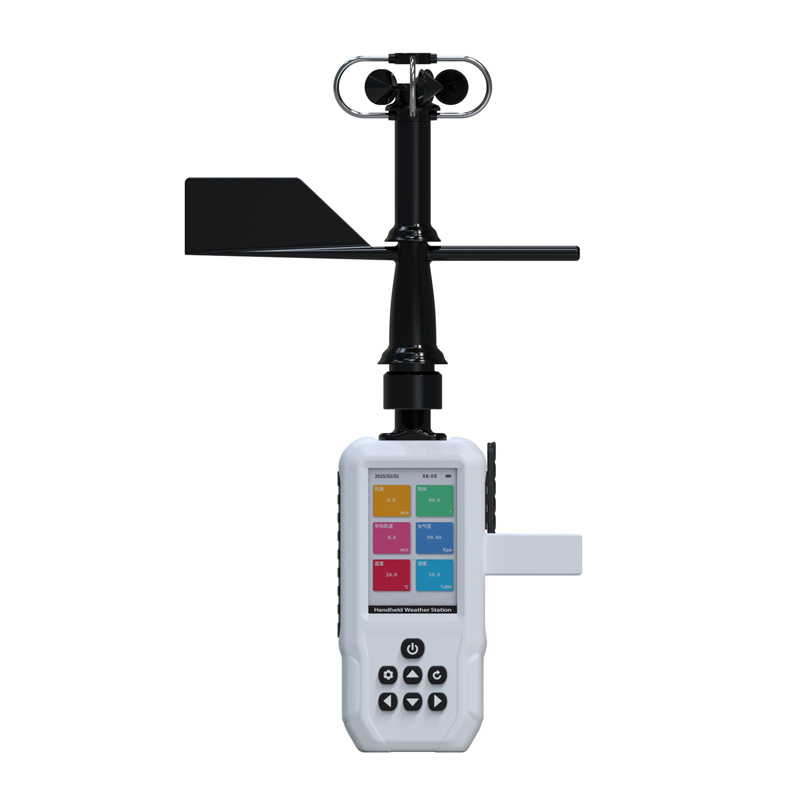
The Portable Weather Station is a highly integrated, low-power, and rapidly deployable device designed for high-precision automated meteorological observation. It supports wireless data transmission and allows for quick, calibration-free deployment. With a total weight of no more than 5 kilogr...


 Skype
Skype
 whatsapp
 mail
mail