Tianqiong Sensor IOT Technology Co., Ltd
Sales Manager:Ms. Emily Wang
Cel,Whatsapp,Wechat:+86 15898932201
Email:info@fengtutec.com
Add:No. 155 Optoelectronic Industry Accelerator, Gaoxin District, Weifang, Shandong, China


Sales Manager:Ms. Emily Wang
Cel,Whatsapp,Wechat:+86 15898932201
Email:info@fengtutec.com
Add:No. 155 Optoelectronic Industry Accelerator, Gaoxin District, Weifang, Shandong, China
time:2025-04-21 09:31:11 source:Weather Station viewed:598 time
The microclimate of farmland refers to the small-scale climatic environment formed by the interaction among the surface air layer, soil layer and crop population in the farmland. It is reflected by the values of agricultural meteorological elements such as radiation, air temperature and humidity, wind, carbon dioxide, as well as soil temperature and humidity. Since crops grow in a specific farmland environment, in different farmland areas, due to factors such as crop types, planting density, and soil conditions, there are significant differences in the microclimate. Moreover, the growth of crops is extremely sensitive to meteorological conditions. Only by accurately grasping the microclimate of farmland can the needs of different growth stages of crops be met. Therefore, it is of great significance to conduct independent monitoring of the microclimate of farmland.
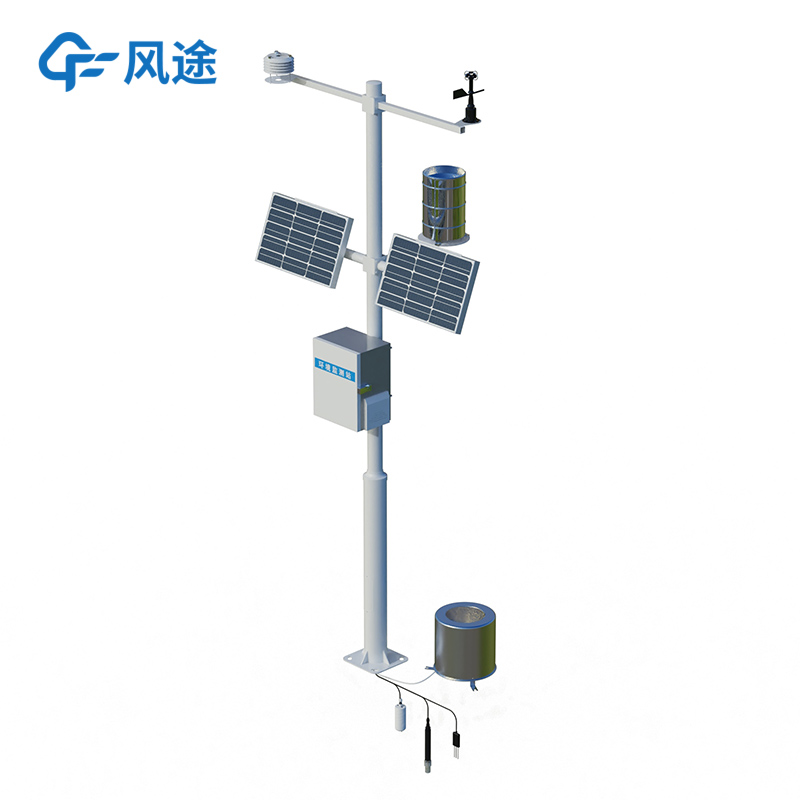
Agricultural Weather Stations are high-tech devices specifically designed to obtain these key meteorological data. It is composed of parts such as sensors, data loggers, communication interfaces, and system power supplies. The sensors detect various meteorological elements, such as environmental temperature, humidity, light intensity, rainfall, wind speed, wind direction, soil temperature and humidity, atmospheric pressure, and other data. The data logger summarizes and organizes the data collected by the sensors, and can complete the collection and storage of a set of data every minute. The communication interface can realize the remote transmission of data, making it convenient for the staff to obtain information in real time. The system uses a solar power supply and is also equipped with a camera, which can regularly take images of crop seedlings, allowing the staff to intuitively understand the growth status of the crops.
In practical applications, through the analysis of the monitored data by Agricultural Weather Stations, the meteorological department can produce detailed and accurate agricultural meteorological service reports, promptly issue early warnings of meteorological disasters, provide farmers with guidance and suggestions on agricultural activities, and help them arrange agricultural activities reasonably. In this way, the growth of crops can be ensured, and the yield and quality of crops can be improved. This is also a key driving force for the development of agriculture towards scientific and efficient directions.
The FT-ML3 Open Channel Flow Monitor is an automated system used for real-time monitoring of water flow in open channels such as rivers and irrigation canals. It is a fully automatic flow telemetry system designed for long-term, continuous monitoring of the entire water flow process in open channels...
Handheld Anemometer is a portable meteorological observation instrument. Its wind speed measurement range is 0–30 m/s with an accuracy of ±0.3 m/s and a resolution of 0.01 m/s. Wind direction measurement range is 16 azimuths with an accuracy of ±1 azimuth. The instrument uses a three-cup ro...
Urban waterlogging is an invisible "underground threat".In recent years, extreme rainfall events have occurred frequently, and many cities have suffered severe waterlogging. News of traffic paralysis, flooded vehicles, and trapped residents are not uncommon, which not only seriously affect...
This handheld anemometer is a portable meteorological observation instrument that can measure multiple parameters in real time, including wind speed, wind direction, temperature, humidity, atmospheric pressure, light intensity, ultraviolet radiation, and runway temperature. It also features SO...


 Skype
Skype
 whatsapp
 mail
mail