Tianqiong Sensor IOT Technology Co., Ltd
Sales Manager:Ms. Emily Wang
Cel,Whatsapp,Wechat:+86 15898932201
Email:info@fengtutec.com
Add:No. 155 Optoelectronic Industry Accelerator, Gaoxin District, Weifang, Shandong, China


Sales Manager:Ms. Emily Wang
Cel,Whatsapp,Wechat:+86 15898932201
Email:info@fengtutec.com
Add:No. 155 Optoelectronic Industry Accelerator, Gaoxin District, Weifang, Shandong, China
time:2025-10-22 09:08:35 source:Weather Station viewed:523 time
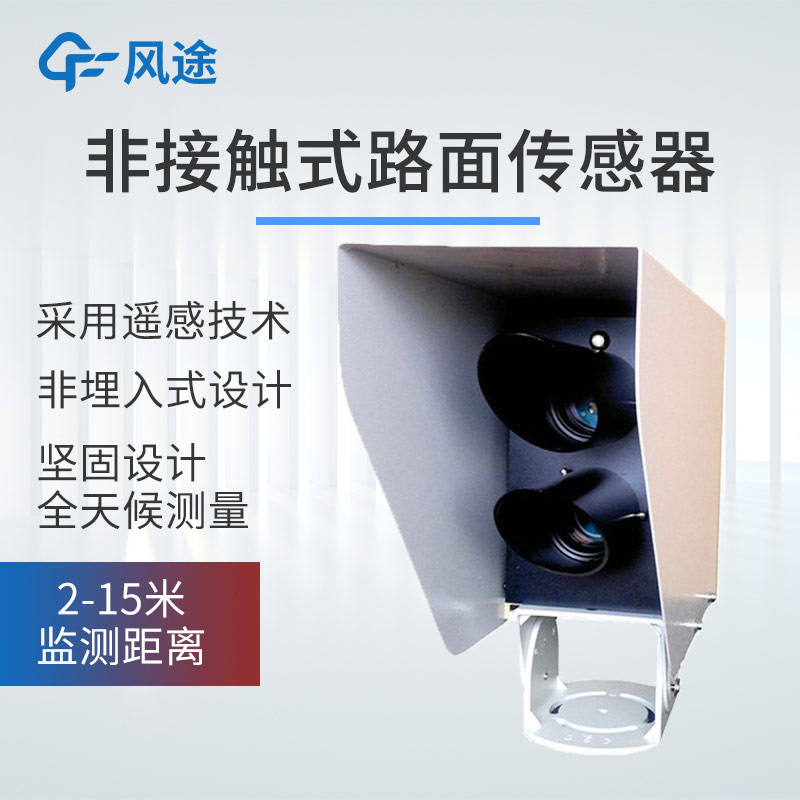
In modern traffic management, real-time and accurate road condition monitoring is of great significance for ensuring driving safety and improving road operation efficiency. Traditional road weather stations typically require embedded installation, which not only damages the road structure but may also disrupt normal traffic flow. The measurement accuracy of contact detection equipment is easily affected by external environments, making it difficult to fully reflect changes in road surface conditions. To address these issues, the FT-LM1 Non-Contact Road Condition Sensor emerged, based on multi-spectral remote sensing technology, achieving high-precision identification and monitoring of road surface conditions, providing reliable hardware support for traffic meteorological services.
The FT-LM1 adopts a remote sensing detection mechanism that does not require embedding in the road surface or drilling construction, fundamentally avoiding damage to the road structure. The installation process is simple and flexible, allowing rapid deployment without interfering with traffic, making it particularly suitable for high-traffic areas and accident-prone road sections.
Through multi-band spectral analysis, the sensor can accurately identify water, snow, and ice conditions on road surfaces and measure their thickness, with a water detection range of 0–10 mm and ice/snow thickness detection range of 0–2 mm. Additionally, the system can determine road surface slipperiness, with a friction coefficient identification range covering 0.01 (slippery) to 0.82 (high friction), providing critical data for road safety warning.
The FT-LM1 Non-Contact Road Condition Sensor can not only report six road surface conditions: dry, wet, slippery, snowy, icy, and ice-water mixture, but also optionally equipped with weather phenomenon monitoring function to identify weather types such as rain, snow, and heavy fog that affect visibility and road safety. Data is transmitted through RS485 or RS232 interfaces, facilitating integration into various traffic monitoring systems.
Application Scenarios:
Real-time monitoring of road surface conditions on highways, bridges, tunnels, and other critical road sections
Winter road safety warning in areas prone to snow disasters, freezing rain, and other meteorological hazards
Urban traffic arteries and accident-prone areas for monitoring slipperiness and water accumulation
Integration with smart highway platforms as the basic sensing unit of road meteorological information systems
Traditional meteorological monitoring often relies on large, fixed national-level weather observation stations. While these stations provide extremely accurate data, they also suffer from high construction costs, low density, and limited coverage. With social development, our demand for meteorologic...
Wind speed monitoring is not only crucial for the promotion of a green lifestyle but also directly affects our daily travel safety and the production environment. When the wind speed is too high, it not only poses a threat to driving safety but may also trigger natural disasters. Therefore, the prec...
Meteorology encompasses a wide range of elements, such as rain, ice, wind, frost, clouds, and temperature, among others. In the power system, "micro-meteorology" is different from what is described in meteorology. Power micro-meteorology refers to the meteorological conditions in a small s...
The Portable el detector is an important device used to detect various defects in photovoltaic (PV) cell modules. It can accurately detect defects such as hidden cracks, fragments, and poor soldering in PV cell modules. These internal defects can seriously affect the service life and long-term power...


 Skype
Skype
 whatsapp
 mail
mail