Tianqiong Sensor IOT Technology Co., Ltd
Sales Manager:Ms. Emily Wang
Cel,Whatsapp,Wechat:+86 15898932201
Email:info@fengtutec.com
Add:No. 155 Optoelectronic Industry Accelerator, Gaoxin District, Weifang, Shandong, China


Sales Manager:Ms. Emily Wang
Cel,Whatsapp,Wechat:+86 15898932201
Email:info@fengtutec.com
Add:No. 155 Optoelectronic Industry Accelerator, Gaoxin District, Weifang, Shandong, China
time:2026-04-13 13:09:00 source:Weather Station viewed:247 time
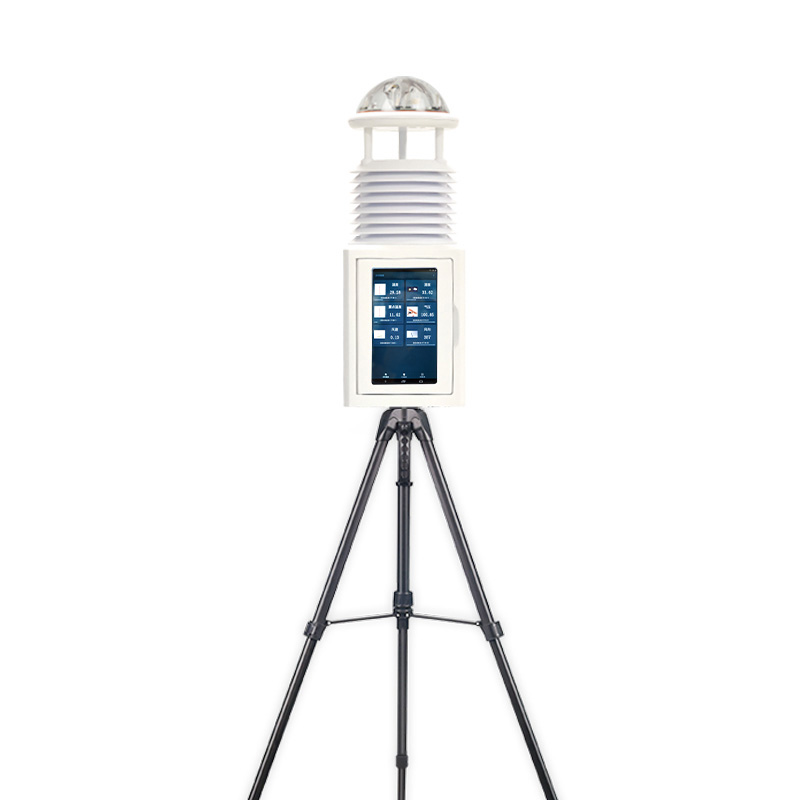
The Portable Weather Station is a highly integrated, low-power, and rapidly deployable device designed for high-precision automated meteorological observation. It supports wireless data transmission and allows for quick, calibration-free deployment. With a total weight of no more than 5 kilograms, the device can be set up by a single person within two minutes, making it ideal for scenarios such as short-term emergency meteorological observation, mobile weather monitoring, agricultural and forestry research, and environmental impact assessments.
As a highly integrated, low-power, and easily installable device, the Portable Weather Station is specifically engineered for convenient use in field monitoring applications. It features wireless transmission capabilities and requires no prior calibration, enabling rapid deployment for the acquisition of meteorological data across various contexts—including emergency weather response and mobile monitoring operations. The device is widely utilized in diverse sectors such as meteorology, agriculture and forestry, environmental protection, marine science, aviation (airports), maritime operations (ports), scientific expeditions, and educational institutions.
Also referred to as a handheld weather meter or mobile weather station, this portable instrument is designed for ease of transport and simplicity of operation, integrating the measurement of multiple meteorological parameters into a single mobile unit. Its core components typically comprise a sensor module, a data acquisition unit, a power supply system, and a communication module. Featuring a fully integrated design, the device is compact in size—typically weighing only a few kilograms—facilitating easy carrying and rapid deployment by a single individual. The unit employs a unified structural design with a total weight not exceeding 5 kilograms; it is equipped with a retractable aluminum alloy tripod stand and a shock-absorbing protective case, allowing for rapid, single-person deployment within two minutes. The device operates effectively across a wide temperature range of -40°C to 85°C. Integrating a multi-parameter sensor array, the device is capable of monitoring ten distinct meteorological elements, including wind speed, wind direction, air temperature, humidity, atmospheric pressure, light intensity, solar radiation, optical precipitation, PM2.5 and PM10 particulate matter, noise levels, soil temperature, soil moisture, and dew point. The unit features an IP65-rated protective enclosure, while its sensor components are constructed from durable ABS material.
In terms of technical performance specifications, the device offers a wind speed measurement range of 0 to 60 m/s, a wind direction measurement range of 0 to 360°, an air temperature measurement range of -40°C to 80°C, a relative humidity measurement range of 0 to 100% RH, and an atmospheric pressure measurement range of 300 to 1100 hPa. The device supports both wired and wireless communication modes, utilizing a variety of transmission methods including Bluetooth, GPRS, 4G, RS232/485, and BeiDou satellite communication. It features a built-in storage capacity of no less than 500,000 data records and integrates with PC-based software, Android applications, and cloud platforms to enable real-time monitoring and data analysis. Equipped with a 12,000mAh lithium battery and supporting optional solar power expansion, the device’s low-power design ensures long-term operation in areas lacking access to mains electricity. During sporting events such as the Nanjing Marathon, these portable weather stations have facilitated the real-time synchronization of meteorological data, effectively addressing the limitations of traditional fixed weather stations regarding spatial coverage and agile responsiveness.
In terms of application scenarios, the portable weather station is suitable for a wide range of fields, including emergency monitoring of meteorological disasters, agricultural microclimate research, environmental support for outdoor events, safety early warning systems for construction sites, and ecological environment surveys. Its primary value lies in its rapid deployment capabilities and flexible mobility, enabling it to reach areas that are inaccessible to traditional fixed stations or that require short-term, temporary observation; thus, it serves as a powerful complement to fixed monitoring networks, real-time situational awareness systems, and emergency response operations. Compared to traditional fixed weather stations, the portable unit weighs only a few kilograms and can be fully installed and commissioned within 30 minutes—whether situated in agricultural fields, mountainous terrain, scenic trails, factory workshops, or school sports grounds. When integrated with remote data center software and monitoring platform software, the portable weather stations form a comprehensive network system encompassing data acquisition, transmission, reception, processing, storage, computation, and display, thereby providing robust data support for a diverse array of on-site meteorological services.
Fluorescent Quantitative PCR Detection System is a laboratory instrument integrating fluorescence optical detection, a temperature control system, and data analysis software. It employs four-channel fluorescence detection and a 48-well reaction module, with a maximum power of 550W and a weight...
In a certain farmland, the LED electronic display of "standard agrometeorological stations" real-time presents data such as soil water content, salinity, and ground temperature, providing key basis for farmers' scientific planting. The new-generation standard agrometeorological station...
Micrometeorology is an important branch of meteorology that studies the physical processes and phenomena in the near-surface atmosphere, typically within a range of a few meters to tens of meters above the Earth's surface. Unlike traditional meteorology that focuses on large-scale weather patter...
Rat Bait Station utilizes the Internet of Things (IoT) and intelligent recognition technology to achieve 24/7 rodent activity data collection and remote control management....


 Skype
Skype
 whatsapp
 mail
mail