Tianqiong Sensor IOT Technology Co., Ltd
Sales Manager:Ms. Emily Wang
Cel,Whatsapp,Wechat:+86 15898932201
Email:info@fengtutec.com
Add:No. 155 Optoelectronic Industry Accelerator, Gaoxin District, Weifang, Shandong, China


Sales Manager:Ms. Emily Wang
Cel,Whatsapp,Wechat:+86 15898932201
Email:info@fengtutec.com
Add:No. 155 Optoelectronic Industry Accelerator, Gaoxin District, Weifang, Shandong, China
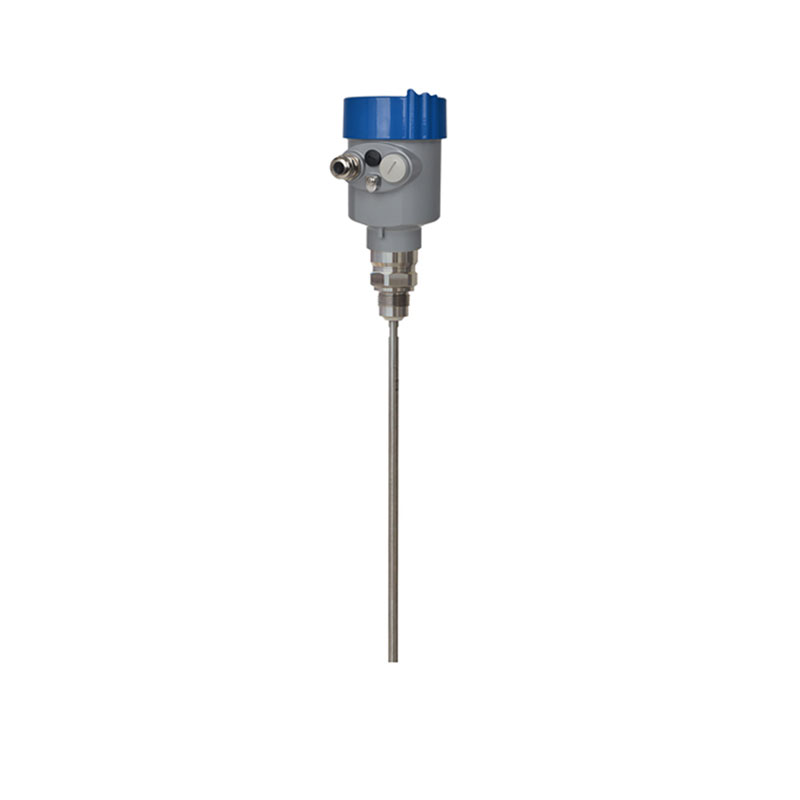
Model:JC-1.8A
Brand:tianqiong
1.Radar level measurement product principle
Radar level measurement determines liquid levels by transmitting and receiving microwave signals, measuring the distance between the liquid surface and the sensor.The high-frequency microwave pulses emitted by the guided wave radar propagate along the detection component (steel cable or steel rod). When encountering the medium to be tested, it causes reflection due to a sudden change in the dielectric constant, and part of the pulse energy is reflected back. The time interval between the emitted pulse and the reflected pulse is proportional to the distance of the medium to be tested.
2.Radar level measurement technical parameters
Applicable media: liquid, solid powder
Application: Liquid and solid powder measurement, complex process conditions
Explosion-proof certification: Exia IIC T6 Ga/Exd ia IIC T6 Gb
Measuring range: 0~20 meters of liquid, 0~10 meters of solid powder
Frequency: 500MHz-1.8GHz
Antenna: Single pole antenna
Measuring accuracy: ±10mm
Process temperature: (-40~250)℃
Process pressure: (-0.1~4) MPa
Signal output: (4~20) mA/HART
On-site display: Four-bit LCD programmable
Power supply: two-wire system (DC24V) / four-wire system (DC24V/AC220V)
Housing: Aluminum/plastic
3. Radar level measurement product features
The antenna is small in size and is easy to install; non-contact radar, no wear and pollution.
Almost not affected by corrosion and foam; almost not affected by changes in water vapor, temperature and pressure in the atmosphere.
Severe dust environments have little impact on the high-frequency level gauge operation.
Shorter wavelengths and better reflect on slanted solid surfaces.
The beam angle is small and the energy is concentrated, which enhances the echo capability while also helps avoid interference.
The measurement blind spot is smaller, and it will also achieve good results for small tank measurements.
High signal-to-noise ratio allows better performance even in fluctuations.
High frequency is the best choice for measuring solid and low dielectric constant.
In the photovoltaic industry, the problem of black edges on photovoltaic modules is quite common. The black edges are mainly caused by poor sealing of the frame during the module encapsulation process, which allows water vapor and oxygen to penetrate, causing oxidation or corrosion at the edges of t...
The "data brain" in farm fields is quietly changing the agricultural production model that has relied on "weather-dependent farming" for thousands of years.In traditional agricultural production, farmers mostly rely on experience to judge agricultural activities. However, as clim...
Integrated Weather Observation System is a high-precision automatic meteorological observation device that integrates sensors for wind speed, wind direction, temperature, humidity, atmospheric pressure, PM2.5, PM10, noise, and other parameters. It utilizes solar power supply and wireless trans...
Surface water quality monitoring uses five standard parameters—water temperature, pH, dissolved oxygen, conductivity, and turbidity—for continuous real-time data collection via online automatic monitoring stations or portable multi-parameter analyzers. This provides fundamental data support...


 Get a Free Quote
 Skype
Skype
 whatsapp
 mail
mail