Tianqiong Sensor IOT Technology Co., Ltd
Sales Manager:Ms. Emily Wang
Cel,Whatsapp,Wechat:+86 15898932201
Email:info@fengtutec.com
Add:No. 155 Optoelectronic Industry Accelerator, Gaoxin District, Weifang, Shandong, China


Sales Manager:Ms. Emily Wang
Cel,Whatsapp,Wechat:+86 15898932201
Email:info@fengtutec.com
Add:No. 155 Optoelectronic Industry Accelerator, Gaoxin District, Weifang, Shandong, China
time:2025-03-14 14:01:52 source:Weather Station viewed:629 time
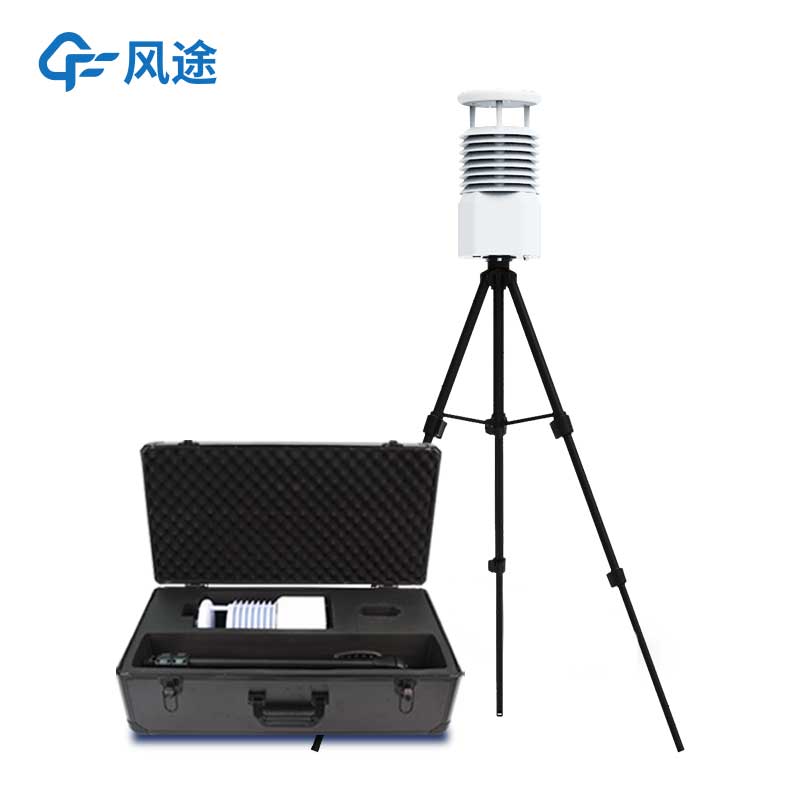
Environmental monitoring centers play a crucial role in atmospheric environment monitoring, responding to sudden environmental incidents, and providing data support for environmental protection decision - making. A portable and powerful mobile weather station is of great significance for improving its work efficiency and monitoring capabilities. The following is the configuration scheme of the Portable Weather Station designed for environmental monitoring centers.
I. Equipment Selection
(1) Sensors
Temperature: High - precision digital temperature sensor with a measurement range of - 40°C to 80°C, a resolution of 0.01°C, and an accuracy of ±0.3°C (at 25°C), which can quickly sense subtle temperature changes.
Humidity: Capacitive humidity sensor with a measurement range of 0 - 100%RH, a resolution of 0.01%RH, and an accuracy of ±3%RH, which can accurately measure air humidity.
Wind speed and direction: The ultrasonic wind speed sensor has a measurement range of 0 - 60m/s, a resolution of 0.1m/s, and an accuracy of 0.1m/s + 0.01v; the ultrasonic wind direction sensor has a measurement range of 0 - 360°, a resolution of 1°, and an accuracy of ±2°. It is anti - interference and reliable.
Air pressure: Piezoresistive air pressure sensor with a measurement range of 30 - 110Kpa, a resolution of 0.1hpa, and an accuracy of ±0.25%, which can monitor air pressure changes.
Rainfall: Optical rainfall sensor with a resolution of 0.01mm and a measurement accuracy of ±4% (rain intensity ≤ 4mm/min), which can accurately measure rainfall.
Illumination: Silicon photocell illumination sensor with a measurement range of 0 - 200000lx, a resolution of 1lx, and an accuracy of ±5%, which can monitor the intensity of illumination.
Particulates: PM2.5 and PM10 sensors based on the principle of laser scattering with a measurement range of 0 - 1000μg/m³, a resolution of 1μg/m³, and an accuracy of ±10% (<500 micrograms), which can monitor air quality.
Optional: Gas sensors such as carbon monoxide and sulfur dioxide can be added as needed.
(2) Data Collector
A high - performance microcomputer data collector that supports the access of sensors, processes and calibrates data in real - time. It has a large - capacity internal storage and can store more than 500,000 data records. It is equipped with RS232/RS485 serial ports, USB, Bluetooth, and 4G communication interfaces.
(3) Power Supply
Battery: A 12000mAh detachable lithium - ion battery with a battery life of more than 32 hours and a battery level display.
Solar energy (optional): A 20 - 50W solar power supply system, including a solar panel, controller, and battery, is used for remote or long - term monitoring scenarios.
(4) Protection and Portability
The equipment is placed in a shock - absorbing trolley case with an IP65 protection level and is equipped with a telescopic and foldable aluminum alloy bracket that can be adjusted from 1 to 3 meters in height. One person can complete the installation and disassembly within 2 minutes.
II. Software and Data Management
(1) Data Reception and Analysis Software
PC - end: Receives data in real - time, displays it in charts, and has functions such as storage, query, statistics, and export, and can generate various reports.
Mobile APP: Allows users to view real - time data, device status, set up early - warning functions, and supports download and sharing.
(2) Cloud Platform
Provides functions such as data storage, backup, visualization, analysis and mining, as well as user management and permission setting. Data is uploaded in real - time through 4G, which is convenient for remote management and sharing.
This configuration scheme features high equipment integration, accurate measurement, portability and ease of use, convenient data transmission, and strong adaptability, which can meet the diverse monitoring needs of environmental monitoring centers.
Gridization is a technical means that divides the geographical space into several regular or irregular grid units. Through independent monitoring, analysis, and management of each grid, it achieves refined management of the entire region. In the field of environmental monitoring, grid-based manageme...
Fluorescent Quantitative PCR Detection System is a laboratory instrument integrating fluorescence optical detection, a temperature control system, and data analysis software. It employs four-channel fluorescence detection and a 48-well reaction module, with a maximum power of 550W and a weight...
The price range for Vehicle Weather Station typically falls between 6800 and 18800 RMB. This device is a mobile weather monitoring station specifically designed for mobile platforms such as vehicles and ships, capable of monitoring core meteorological elements such as temperature, humidity, wi...
Urban waterlogging is an invisible "underground threat".In recent years, extreme rainfall events have occurred frequently, and many cities have suffered severe waterlogging. News of traffic paralysis, flooded vehicles, and trapped residents are not uncommon, which not only seriously affect...


 Skype
Skype
 whatsapp
 mail
mail