Tianqiong Sensor IOT Technology Co., Ltd
Sales Manager:Ms. Emily Wang
Cel,Whatsapp,Wechat:+86 15898932201
Email:info@fengtutec.com
Add:No. 155 Optoelectronic Industry Accelerator, Gaoxin District, Weifang, Shandong, China


Sales Manager:Ms. Emily Wang
Cel,Whatsapp,Wechat:+86 15898932201
Email:info@fengtutec.com
Add:No. 155 Optoelectronic Industry Accelerator, Gaoxin District, Weifang, Shandong, China
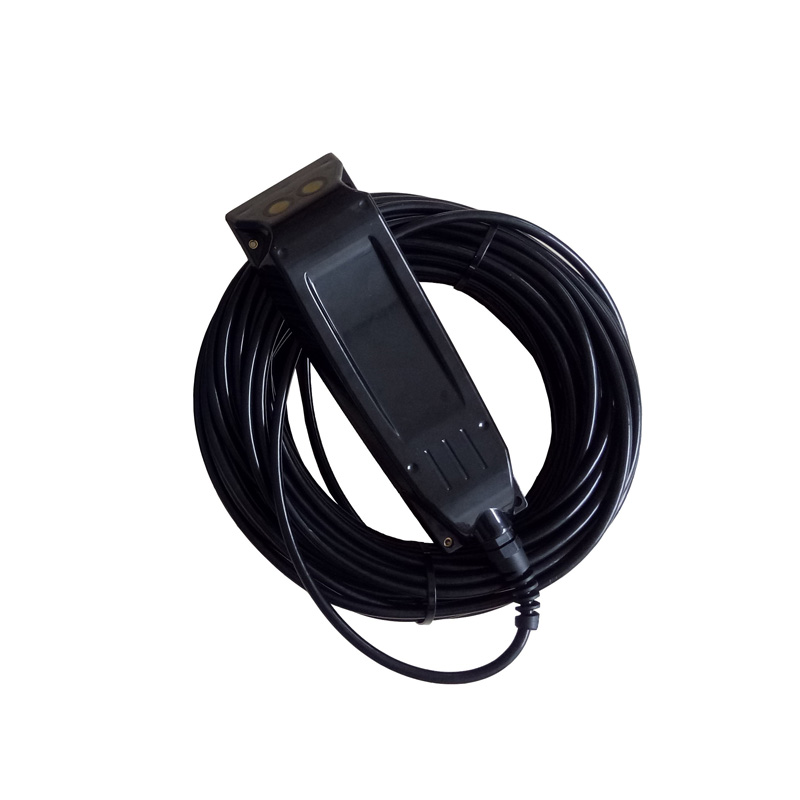
Model:FT-L1S2
Brand:tianqiong
1.Ultrasonic Flow Meter product principle:
Ultrasonic Flow Meter is an intrusive device that measures volumetric flow and is ideal for wastewater applications or any dirty liquid that conducts electricity.In the field of acoustics, when there is relative movement between the sound source and the receiver (i.e., the probe and the reflector), the frequency of the echo will change.This frequency change is called frequency shift, that is, the Doppler effect.The frequency of the sound wave becomes higher when moving towards the observer and lower when moving away from the observer.The Doppler flow meter calculates the flow velocity by calculating the frequency change.
2.Ultrasonic Flow Meter technical parameters
1.Power supply: DC10-15V
2.Working current: approximately 10mA standby, 60mA measurement
3.Sound wave frequency: 2MHZ
4.Blind spot: 10 cm
5.Flow rate range: 0.02-10 meters/sec
6.Water depth range: 0.02-5 meters
7.Temperature: 0-50°
8.Measurement cycle: 20 seconds
9.Sensor material: ABS, stainless steel
10.Output interface: RS485
11.Working water depth: 0.2 meters-5 meters
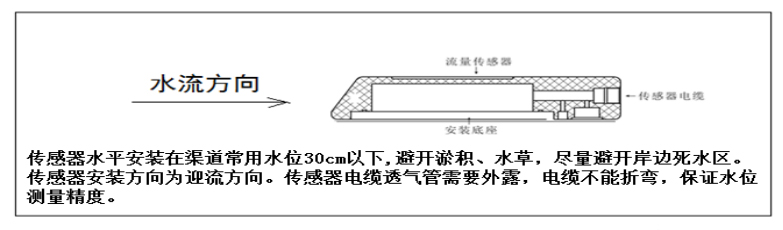
3.Ultrasonic Flow Meter installation instructions:
Normal installation ensures 20CM below the minimum water level to avoid exposing the water
Sensor installation diagram:
4.Things to note about Ultrasonic Flow Meter
1.The sensor needs to avoid silt and collisions of objects such as gravels.Where there are many aquatic plants, grilles need to be installed to prevent aquatic plants from entangling.
2.Sensor installation direction, the sensor transmission surface needs to be installed in the flow direction.
3.The sensor has a sound wave blind spot.Try to ensure that the sensor is below 20 cm underwater (the sensor may have false data under semi-exposed water or blocked by sludge, and the probability is very low.Usually, the data will appear large numbers such as more than 2 meters/second.It is recommended that secondary developers use sensors to shield the large flow rate value by the water level, or the water flow rate is not that large in actual application scenarios, which can directly shield the flow rate greater than 2 meters or more).
4.The cable vent pipe is not difficult to break, affecting the water level measurement.
5.Try to do a good job in signal and power lightning protection.
6.If the sensor cable is connected to a length, you need to add a 485 relay, and the power supply avoids the interference of the inverter.
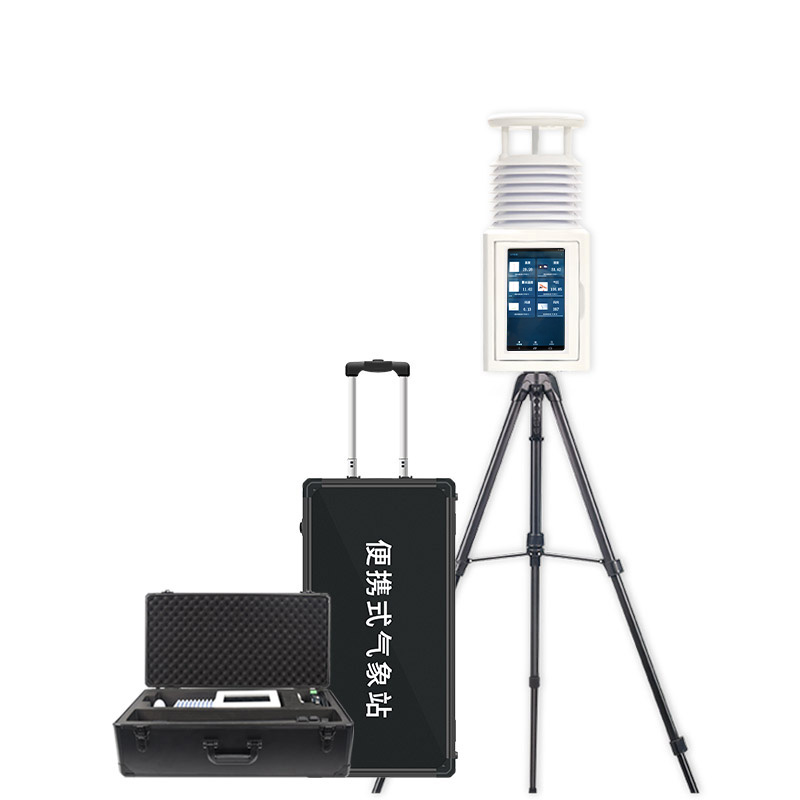
Ground-based meteorological observation statio is a multi-parameter automatic weather station that monitors multiple parameters in real time....
In low-temperature and snowy weather, bridge icing is a serious problem. Bridge icing not only affects the stability of the bridge structure and shortens its service life, but also poses a great threat to the safety of passing vehicles and pedestrians, and is extremely likely to cause traffic accide...
In the production and use of photovoltaic modules, grid breakage is a relatively common and thorny problem. Grid breakage refers to the existence of breakpoints in the silver paste printing of the main grid of the solar cell, which causes the fine grid lines on the solar cell to be open-circuited wi...
In the context of the increasingly accelerating urbanization process today, air quality has become one of the key elements for measuring the quality of life. However, due to the high construction and operation costs and fixed layout, traditional large-scale environmental monitoring stations find it...


 Get a Free Quote
 Skype
Skype
 whatsapp
 mail
mail