Tianqiong Sensor IOT Technology Co., Ltd
Sales Manager:Ms. Emily Wang
Cel,Whatsapp,Wechat:+86 15898932201
Email:info@fengtutec.com
Add:No. 155 Optoelectronic Industry Accelerator, Gaoxin District, Weifang, Shandong, China


Sales Manager:Ms. Emily Wang
Cel,Whatsapp,Wechat:+86 15898932201
Email:info@fengtutec.com
Add:No. 155 Optoelectronic Industry Accelerator, Gaoxin District, Weifang, Shandong, China
time:2026-06-18 10:34:37 source:Weather Station viewed:104 time
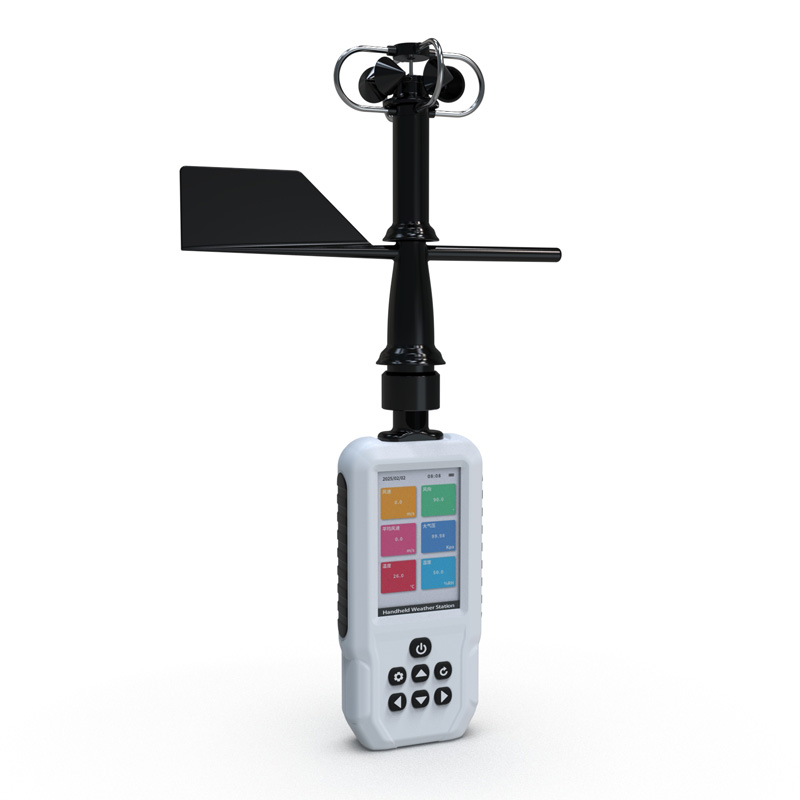
electronic weather station is a handheld multi-element meteorological observation device that simultaneously measures wind speed, wind direction, temperature, humidity, air pressure, altitude, thermal index, wet-bulb temperature, dew point, wind chill, wave height, and GNSS positioning. With built-in storage and a Type-C interface, it is suitable for outdoor exploration, agriculture, environmental protection, and emergency rescue.
electronic weather station is a handheld device integrating multiple environmental sensors, designed to quickly acquire on-site meteorological data while on the move. The instrument typically includes a wind cup or ultrasonic transducer for measuring wind speed, an integrated probe for measuring temperature and humidity, a MEMS piezoresistive sensor for measuring atmospheric pressure, and a GNSS receiver module for positioning and altimetry. Upon power-on, the instrument displays the current wind speed, wind direction (with electronic compass assistance), temperature, relative humidity, atmospheric pressure, and altitude within seconds. Furthermore, through built-in algorithms, it can further calculate the thermal index, wet-bulb temperature, dew point temperature, wind chill index, and wave height. These extended parameters are valuable for specific scenarios. For example, the thermal index, which combines temperature and humidity, is used to assess the risk of heat stress in humans; the wind chill index reflects the effect of wind speed on perceived temperature, guiding clothing and work duration in cold environments.
Regarding data recording, the electronic weather station features a built-in high-capacity FLASH storage chip, capable of continuously recording all measurement elements at minute or second intervals, with storage capacity covering a full year's worth of data (depending on the sampling interval). Users don't need to worry about data loss, as storage employs a cyclic overwrite mechanism. The device is equipped with a Type-C interface, which serves both charging and data transfer functions. When connected to a computer, the instrument is recognized as an external storage device, allowing users to directly copy stored files or read and generate standard meteorological data tables using the accompanying software, facilitating subsequent statistical analysis or import into GIS systems.
GNSS tri-mode positioning is a key feature of this device. It simultaneously supports BeiDou, GPS, and GLONASS satellite systems. Compared to GPS alone, it can acquire more available satellites in canyons, dense forests, or urban high-rise areas, improving positioning success rate and accuracy. Location information not only displays longitude, latitude, and altitude, but also marks the geographical location of each data point, which is crucial for multi-point mobile monitoring. For example, when environmental monitoring personnel patrol along rivers, each measurement value can be automatically linked to specific coordinates, forming a spatial distribution map.
electronic weather station has a wide range of applications. In outdoor adventures, mountaineers use altitude changes and air pressure trends to predict weather changes; agricultural growers measure field temperature, humidity, and wind speed to schedule pesticide spraying and irrigation; emergency rescue teams use real-time wind speed and direction to determine the direction of fire spread or the path of chemical gas diffusion; and scientific research and teaching institutions utilize its portability for microclimate surveys and practical teaching. The device typically uses AA batteries or a built-in lithium battery, with a battery life sufficient for all-day field work. It has an IP67 protection rating, is dustproof and waterproof, and adaptable to various outdoor weather conditions. Overall, electronic weather station, with its lightweight, multifunctional, and easy-to-operate features, has become a practical tool for mobile meteorological observation.
Fentu Technology, a manufacturer of radar water level gauges, offers an 80GHz high-frequency radar gauge utilizing Frequency Modulated Continuous Wave (FMCW) technology. With a measurement range of 0.1 to 40 meters, an accuracy of ±5 mm, and a resolution of 1 mm, this device features a non-co...
As a device widely used in fields such as water conservancy monitoring, environmental governance, and engineering construction, a flow meter can monitor water flow velocity data in real time with high accuracy, providing a scientific basis for decision-making. Currently, mainstream flow meters on th...
Home Weather Station is a portable environmental monitoring instrument used for on-site air quality monitoring. This device can measure multiple parameters in real time, including wind speed, wind direction, temperature, humidity, air pressure, PM2.5, PM10, and noise, providing an integrated on-site data acquisition solution for environmental assessment, industrial safety, and scientific research....
In traditional cognition, agricultural production has often "relied on the weather", and weather changes have a huge impact on crop growth. Especially during the Sanfu days (the peak summer heat period), extreme weather such as high temperatures, high humidity, and heavy rainfall occurs fr...


 Skype
Skype
 whatsapp
 mail
mail