Tianqiong Sensor IOT Technology Co., Ltd
Sales Manager:Ms. Emily Wang
Cel,Whatsapp,Wechat:+86 15898932201
Email:info@fengtutec.com
Add:No. 155 Optoelectronic Industry Accelerator, Gaoxin District, Weifang, Shandong, China


Sales Manager:Ms. Emily Wang
Cel,Whatsapp,Wechat:+86 15898932201
Email:info@fengtutec.com
Add:No. 155 Optoelectronic Industry Accelerator, Gaoxin District, Weifang, Shandong, China
time:2025-12-26 10:43:05 source:Weather Station viewed:447 time
Handheld Anemometer is a portable meteorological instrument used for measuring wind speed and direction. It is easy to operate and can accurately measure both meteorological elements simultaneously. It is widely used in meteorology, environmental protection, aviation, and various outdoor engineering activities.
Handheld Anemometer is an instrument that measures the speed and direction of horizontal air movement. Its core function is to quantitatively obtain wind speed and wind direction data. Wind speed is usually expressed in meters per second, kilometers per hour, or knots, while wind direction is indicated by angle or compass direction. Modern Handheld Anemometer are mostly integrated designs, combining sensors, data processors, and display units into a portable and easy-to-operate mobile observation device.
The working principle of Handheld Anemometer varies mainly depending on the sensor type. Common mechanical Handheld Anemometer use the rotation speed of wind cups or propellers to measure wind speed, and wind direction is indicated by a tail fin or wind vane. Thermal Handheld Anemometer calculate wind speed by measuring the heat carried away from a heating element by the fluid, suitable for low wind speed measurements. Ultrasonic Handheld Anemometer deduce wind speed and direction by calculating the time difference of ultrasonic waves propagating in the air, with no moving parts and high reliability. Currently, handheld or portable Handheld Anemometer mostly use mechanical or ultrasonic principles to balance measurement accuracy, response speed, and equipment cost.
As a mobile observation tool, portable Handheld Anemometer has significant technical characteristics. It has a compact structure, is lightweight, and usually has a built-in rechargeable battery, supporting long-term field work. After the instrument is turned on, it automatically enters the measurement state, displaying instantaneous wind speed, average wind speed, maximum wind speed, and current wind direction on the screen in real time. Some models have data recording functions, capable of storing thousands of sets of measurement data and exporting them via USB or Bluetooth interface. Advanced models may also integrate additional sensors such as temperature and humidity, enabling integrated observation of more meteorological elements. The operating interface is designed to be simple, allowing users to complete basic measurement tasks without complex training.
In practical applications, Handheld Anemometer plays an indispensable role. In meteorological observation, it is not only a component of fixed weather stations but also an essential tool for temporary meteorological surveys, weather phenomenon tracking, and on-site data comparison. In environmental monitoring, environmental protection personnel use it to assess pollution dispersion conditions and monitor the impact of construction dust or industrial emissions on the environment. In the aerospace field, Handheld Anemometer is used for monitoring wind conditions on airport runways, ensuring the safety of aircraft takeoffs and landings, and also for environmental assessment before drone flights. In numerous outdoor engineering and activity settings such as construction, forestry, agriculture, field research, and sailing, real-time wind field information is crucial for safe decision-making and operational efficiency.
When choosing Handheld Anemometer, key parameters should be considered based on the specific application scenario. The measurement range should cover the maximum wind speed expected; the resolution and accuracy must meet the requirements of the observation task; the response time determines the instrument's ability to capture sudden changes in wind speed; and the protection level relates to the equipment's durability in harsh environments such as rain, snow, and dust. During daily use, it is important to keep the sensor clean, avoid collisions, and perform regular calibration to ensure the long-term reliability of the measurement data.
In summary, Handheld Anemometer, as a fundamental and important measurement tool, provides critical airflow information to various industries with its portability, accuracy, and reliability. From professional meteorological research to daily production activities, understanding wind conditions relies on this instrument. With advancements in sensing and IoT technologies, Handheld Anemometer is becoming more intelligent and networked, further expanding its application value in refined monitoring and safety management.
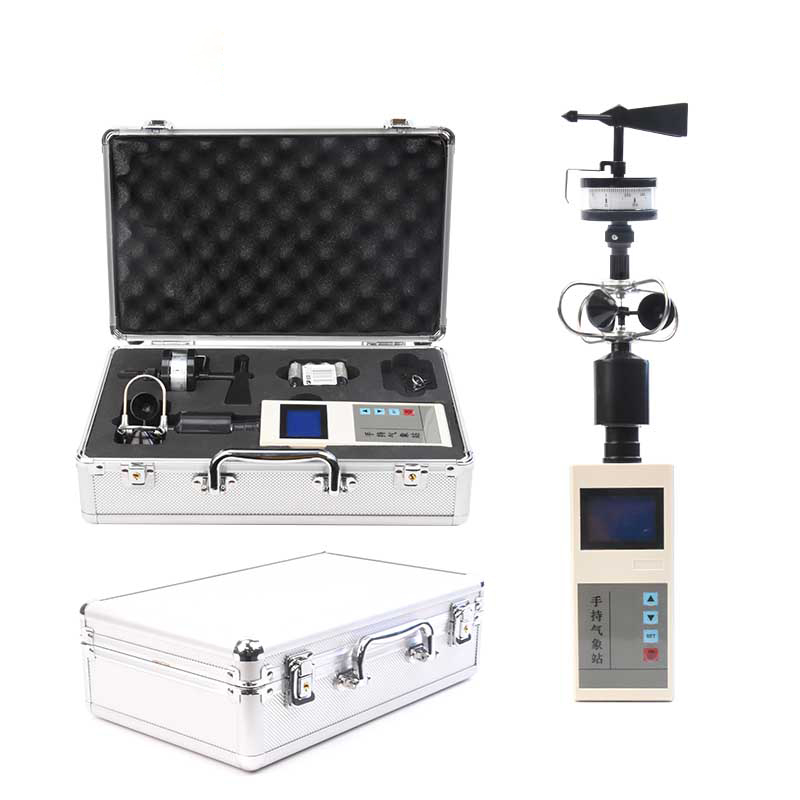
Handheld Anemometer is an instrument used to measure air flow speed and direction. It features automatic monitoring, real-time display, and over-limit alarm functions, and is widely used in meteorology, environmental monitoring, and industrial safety....
An automatic weather station is a highly integrated, low-power, and quickly installable automatic meteorological observation device. It uses a twelve-element integrated sensor to monitor parameters such as wind speed, wind direction, temperature, humidity, air pressure, rainfall, and PM2.5 in...
The electronic weather instrument is a portable multi-element meteorological observation equipment that integrates wind speed, wind direction, temperature, humidity, air pressure, altitude and other sensors. It has a built-in large-capacity storage chip and Type-C communication interface. It c...
Based on microwave radar technology, the system measures water level, flow velocity, flow rate, and rainfall in channels non-contactly. It is unaffected by temperature, sediment, or floating debris, making it suitable for rivers, irrigation canals, and flood control early warning systems....


 Skype
Skype
 whatsapp
 mail
mail