Tianqiong Sensor IOT Technology Co., Ltd
Sales Manager:Ms. Emily Wang
Cel,Whatsapp,Wechat:+86 15898932201
Email:info@fengtutec.com
Add:No. 155 Optoelectronic Industry Accelerator, Gaoxin District, Weifang, Shandong, China


Sales Manager:Ms. Emily Wang
Cel,Whatsapp,Wechat:+86 15898932201
Email:info@fengtutec.com
Add:No. 155 Optoelectronic Industry Accelerator, Gaoxin District, Weifang, Shandong, China
time:2026-09-20 10:16:16 source:Weather Station viewed:0 time
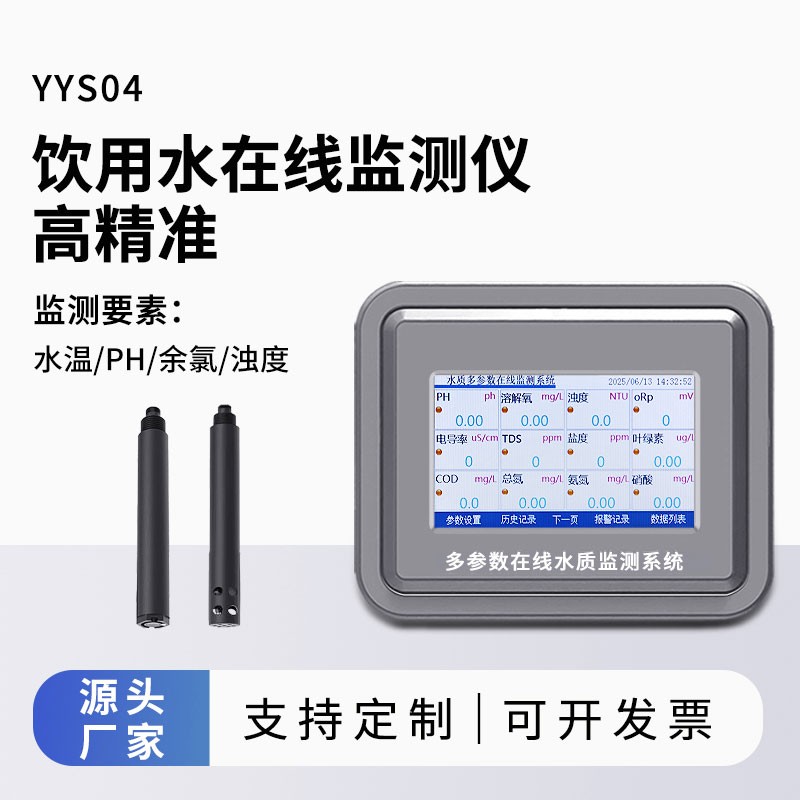
Drinking Water Monitoring provides round-the-clock, real-time monitoring of key water quality parameters—such as residual chlorine, pH, turbidity, and temperature. It supports sensor expansion and data storage/export, utilizes standard communication protocols, and is adaptable to various monitoring scenarios and system integration requirements.
Drinking Water Monitoring serves as a core automated monitoring instrument for water quality management. It continuously collects and records critical water quality parameters, leveraging proven detection technologies to ensure data timeliness and accuracy. Standard monitoring parameters include residual chlorine, pH, turbidity, and temperature, measured via ion-selective electrode, electrochemical salt bridge, and scattered light methods, respectively. Each parameter offers high precision and fine resolution, enabling the detection of subtle changes in water quality and ensuring compliance with standard testing requirements.
Drinking Water Monitoring offers flexible configuration options, allowing for the addition of multi-parameter water quality sensors and the expansion of monitoring metrics based on specific site needs. An integrated data storage system retains daily monitoring data and alarm histories, allowing users to retrieve or export data offline at any time. This ensures full traceability of monitoring data, providing comprehensive support for water quality analysis, root-cause investigation, and process optimization.
Regarding communication, Drinking Water Monitoring features a standard RS485 interface and supports the MODBUS-RTU protocol, ensuring excellent compatibility. The instrument integrates seamlessly with industrial and monitoring equipment—such as PLCs, DCSs, SCADA/HMI software, and DTUs—for rapid data transmission. It fits easily into smart water management and industrial automation systems, thereby reducing integration costs and simplifying operation and maintenance.
With its stable performance and comprehensive functionality, this monitor is suitable for a wide range of applications, including water quality control in municipal water plants, routine groundwater monitoring, ecological monitoring of rivers and lakes, and marine water quality testing. It is also well-suited for wastewater treatment process control, industrial process water monitoring, and scientific research applications. The equipment overcomes the drawbacks of traditional manual inspection—such as low frequency, high error rates, and data lag—and leverages the advantages of automation, high precision, and round-the-clock monitoring to provide reliable technical support for the safety management and water quality optimization of various water bodies.
The Buoy Type Water Quality Online Monitoring System is a self-developed miniaturized automatic water quality monitoring system, leveraging years of R&D experience in meteorological stations. It adopts a pre-integrated outdoor monitoring design with a small footprint, and integrates multiple tec...
Since its establishment, TianQiong has been focusing on the research and development, production, sales, and service of hydrometeorological equipment. Relying on a complete production chain and a professional technical team, it has developed rapidly in the industry.TianQiong offers a rich variety of...
Fluorescent Quantitative PCR Detection System is a laboratory instrument integrating fluorescence optical detection, a temperature control system, and data analysis software. It employs four-channel fluorescence detection and a 48-well reaction module, with a maximum power of 550W and a weight...
In the modern industrial field, the chemical industry has an extremely high demand for meteorological monitoring. The chemical production process is complex and involves many flammable, explosive, and corrosive chemical substances. For example, in a chemical industrial park, under different meteorol...


 Skype
Skype
 whatsapp
 mail
mail