Tianqiong Sensor IOT Technology Co., Ltd
Sales Manager:Ms. Emily Wang
Cel,Whatsapp,Wechat:+86 15898932201
Email:info@fengtutec.com
Add:No. 155 Optoelectronic Industry Accelerator, Gaoxin District, Weifang, Shandong, China


Sales Manager:Ms. Emily Wang
Cel,Whatsapp,Wechat:+86 15898932201
Email:info@fengtutec.com
Add:No. 155 Optoelectronic Industry Accelerator, Gaoxin District, Weifang, Shandong, China
time:2026-04-14 10:56:20 source:Weather Station viewed:289 time
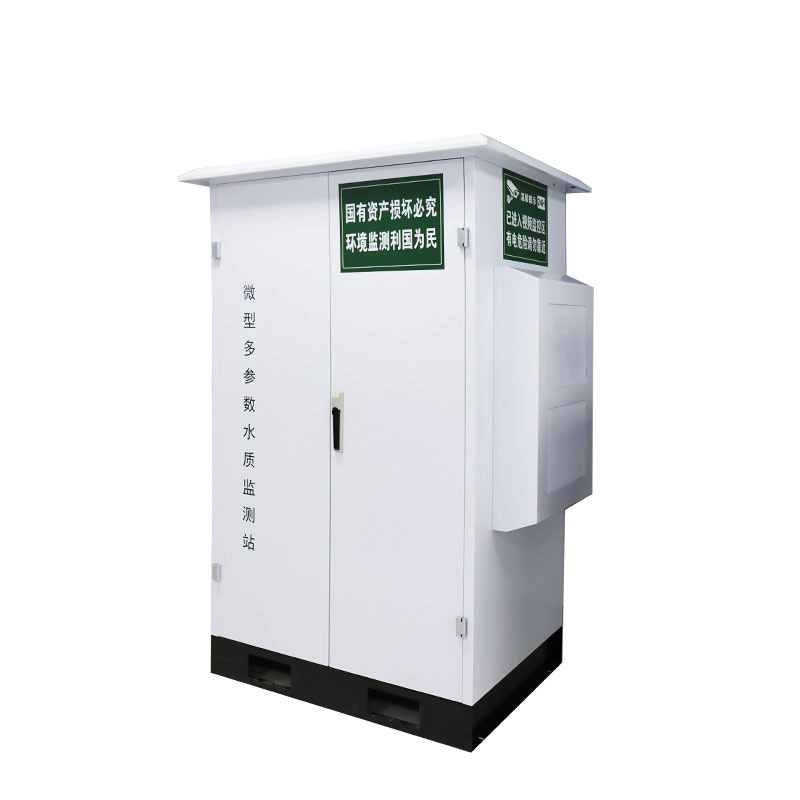
The Miniature Water Quality Monitoring Station features an integrated design comprising a water sampling and distribution system, a detection unit, a quality control unit, and an auxiliary unit. Within the detection unit, the five modules—measuring Total Phosphorus, Total Nitrogen, Chemical Oxygen Demand (COD), Permanganate Index, and Ammonia Nitrogen—strictly adhere to national-standard chemical analysis methods.
The Miniature Water Quality Monitoring Station is a novel online water quality monitoring product designed to meet the demands for high-density, low-cost, and high-frequency monitoring in sectors such as environmental protection, water conservancy, and water utilities. Employing an integrated design philosophy, the device consists of four main components: the water sampling and distribution system, the detection unit, the quality control unit, and the auxiliary unit. The auxiliary unit encompasses a waste liquid collection device, a lightning protection module, and an air conditioning system, ensuring the device's long-term, stable operation in outdoor environments.
The detection unit serves as the core of the Miniature Water Quality Monitoring Station, housing five modules for measuring chemical parameters and one module for measuring physical parameters. The five chemical modules—covering Total Phosphorus, Total Nitrogen, COD, Permanganate Index, and Ammonia Nitrogen—strictly follow the chemical analysis methods stipulated by national standards; they feature low detection limits and fully comply with the technical requirements for online surface water monitoring. The five standard physical parameters—Dissolved Oxygen, Conductivity, Turbidity, Temperature, and pH—are measured simultaneously using an integrated multi-electrode array, requiring no chemical reagents, offering rapid response times, and incurring low maintenance costs.
Regarding the water sampling and distribution system, the device is equipped with water sample pretreatment and backflushing capabilities, effectively reducing the frequency of pipeline blockages and minimizing maintenance workload. The sampling unit utilizes a submersible pump to draw water samples from the monitored water body, which are then distributed to the various analysis modules via the distribution unit. The quality control unit is responsible for calibrating the analysis process and auditing data to ensure the validity and accuracy of the output results. Within the auxiliary unit, the waste liquid collection device has the capacity to store waste liquid generated over a period of more than two weeks, while the lightning protection module and air conditioning system safeguard the device's normal operation during thunderstorms and under extreme temperature conditions.
The Miniature Water Quality Monitoring Station features a compact footprint; the entire unit typically occupies an area of just 1 to 2 square meters. It requires no land acquisition or the construction of dedicated housing, offers flexible installation options, and can be deployed along the banks of various water bodies, including rivers, lakes, and reservoirs. The device supports 4G wireless transmission and the HJ212-2017 communication protocol, enabling seamless integration with environmental regulatory platforms to achieve unattended, continuous automatic monitoring. Measurement data can be transmitted remotely to a cloud server, allowing administrators to view real-time water quality conditions via a mobile app or desktop interface; the system automatically triggers an alarm whenever monitoring parameters exceed preset thresholds. This miniature water quality monitoring station primarily serves application scenarios such as grid-based surface water monitoring for environmental protection agencies, water resource management for water conservancy departments, water supply safety assurance for water utilities, and wastewater discharge oversight for industrial enterprises.
Faced with numerous types of anemometers on the market, how can one select a product that meets their own needs? First, let's understand the common types of anemometers.Mechanical AnemometerAmong mechanical anemometers, the cup anemometer is relatively common. It relies on the rotation of cups u...
FT-NQ8 Meteorological Observation Station, specifically designed for agriculture, can accurately monitor 8 key elements. Each of these 8 elements is closely related to crop growth. Temperature is a key factor affecting the growth rate and physiological activities of crops. Different crops have speci...
Magnetostrictive static levels are high-precision measuring devices based on the magnetostrictive principle and communicating vessel technology. They enable multi-point relative settlement monitoring with high accuracy, strong stability, and no need for periodic calibration, making them widely...
There is a hidden hazard invisible to the naked eye in solar photovoltaic panels —— hidden cracks. This hazard can negatively impact the performance and lifespan of photovoltaic power generation systems. Let’s take a detailed look at it.Hidden cracks refer to fine cracks that occur in the cells o...


 Skype
Skype
 whatsapp
 mail
mail