Tianqiong Sensor IOT Technology Co., Ltd
Sales Manager:Ms. Emily Wang
Cel,Whatsapp,Wechat:+86 15898932201
Email:info@fengtutec.com
Add:No. 155 Optoelectronic Industry Accelerator, Gaoxin District, Weifang, Shandong, China


Sales Manager:Ms. Emily Wang
Cel,Whatsapp,Wechat:+86 15898932201
Email:info@fengtutec.com
Add:No. 155 Optoelectronic Industry Accelerator, Gaoxin District, Weifang, Shandong, China
time:2025-04-17 09:45:14 source:Weather Station viewed:493 time
In contemporary society, air quality is intricately intertwined with our daily lives. Air pollution not only takes a toll on our physical well-being but also exerts adverse effects on the ecological environment and economic development. Globally, air pollution has given rise to a surge in respiratory diseases, frequent crop yield reductions, and other issues. As a result, the accurate and timely monitoring of air quality has become of utmost importance.
The Air quality monitoring station, an emerging monitoring device, is gradually making its way into the public eye. It is a compact, intelligent, and user-friendly air quality monitoring apparatus. Despite its diminutive size, it packs a powerful punch in terms of functionality. The micro-station integrates sensor technology, enabling it to monitor key pollutant indicators in the air with real-time precision. For instance, common pollutants like PM2.5 and PM10, which are major contributors to smoggy weather, can have their concentration fluctuations tracked in real-time by the micro-station. Additionally, gaseous pollutants such as sulfur dioxide and nitrogen dioxide can also have their content variations in the air monitored by the micro-station. Moreover, leveraging Internet of Things (IoT) technology, the micro-station can swiftly transmit the monitored data to cloud platforms or relevant regulatory authorities, facilitating the rapid sharing and analysis of the data.
When compared to traditional large-scale air quality monitoring stations, the Air quality monitoring station boasts numerous advantages. Firstly, it offers high flexibility. Due to its compact size, its installation is not subject to many spatial constraints. It can be effortlessly set up in streets and alleys, remote rural areas, or around specific locations like factories and schools, allowing for targeted air quality monitoring. This helps to fill the gaps in the coverage areas of large-scale monitoring stations. Secondly, the micro-station enables high-density point-based monitoring. By deploying a large number of micro-stations within a certain area, a dense monitoring network can be established, providing comprehensive, all-round monitoring of the air quality in that region without any blind spots. This allows for the detection of more detailed changes in air quality, providing environmental management departments with more comprehensive and accurate data, leaving pollution problems exposed. Furthermore, the micro-station is relatively cost-effective. Whether it's the equipment procurement cost or the subsequent installation and maintenance expenses, they are significantly lower than those of large-scale monitoring stations. This makes it feasible to establish more monitoring points within limited budgetary constraints, thereby expanding the scope of air quality monitoring.
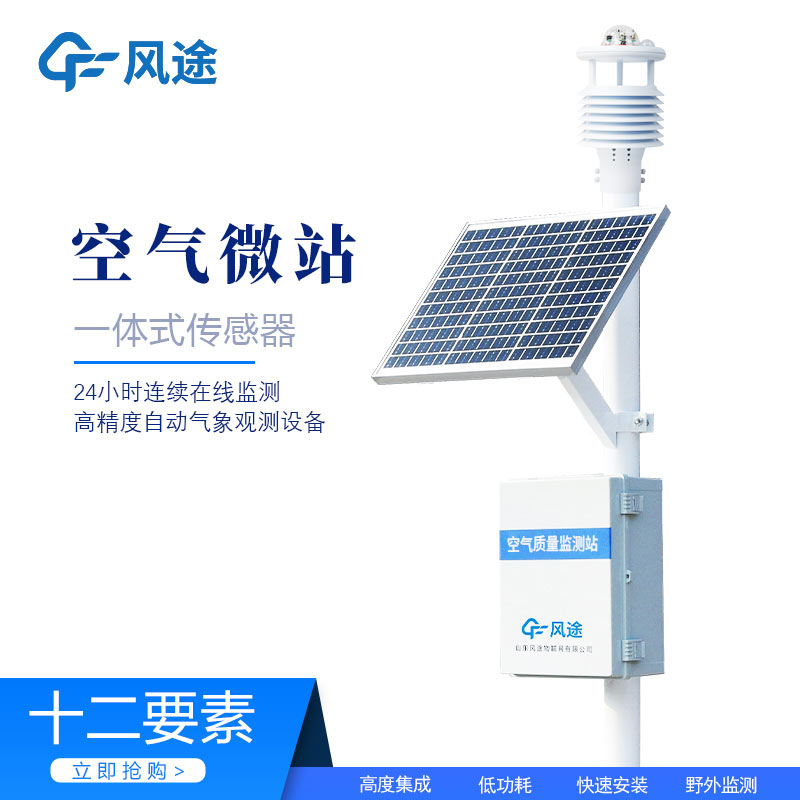
The FT-WQX series miniature sensors are highly integrated meteorological monitoring devices. Their unified design incorporates multiple meteorological parameter monitoring functions into a single structure, making them widely applicable in fields such as meteorological monitoring, urban environmenta...
All - in - One Weather Sensors represent a significant technological update in the field of modern meteorological monitoring. Through a highly integrated design, it combines traditional discrete measurement modules into a single device, enabling the synchronous collection of all - element meteorolog...
The price range for Vehicle Weather Station typically falls between 6800 and 18800 RMB. This device is a mobile weather monitoring station specifically designed for mobile platforms such as vehicles and ships, capable of monitoring core meteorological elements such as temperature, humidity, wi...
The demand for meteorological information is increasing day by day with the development of modern society. Precise meteorological data is of vital importance in fields such as agricultural production, outdoor activities, and emergency rescue. Although traditional fixed weather stations can provide s...



 Skype
Skype
 whatsapp
 mail
mail