Tianqiong Sensor IOT Technology Co., Ltd
Sales Manager:Ms. Emily Wang
Cel,Whatsapp,Wechat:+86 15898932201
Email:info@fengtutec.com
Add:No. 155 Optoelectronic Industry Accelerator, Gaoxin District, Weifang, Shandong, China


Sales Manager:Ms. Emily Wang
Cel,Whatsapp,Wechat:+86 15898932201
Email:info@fengtutec.com
Add:No. 155 Optoelectronic Industry Accelerator, Gaoxin District, Weifang, Shandong, China
time:2026-07-21 10:41:59 source:Weather Station viewed:28 time
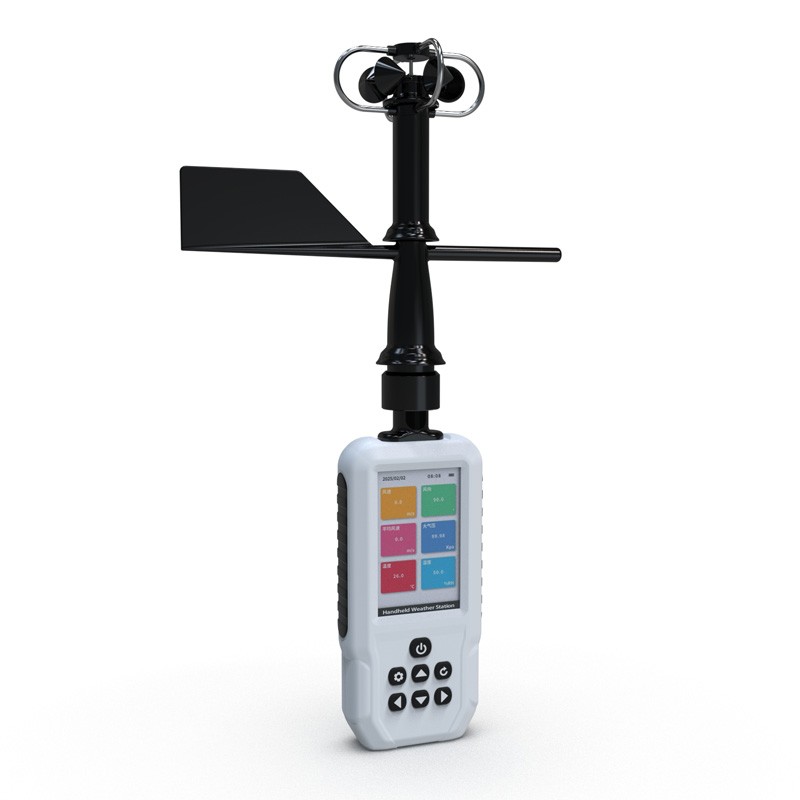
The electronic weather instrument is a portable multi-element meteorological observation equipment that integrates wind speed, wind direction, temperature, humidity, air pressure, altitude and other sensors. It has a built-in large-capacity storage chip and Type-C communication interface. It can be widely used in meteorological monitoring, environmental protection assessment, agricultural and forestry scientific research, airport operations, military support and other fields.
An electronic meteorological instrument is a portable observation device that integrates monitoring of multiple meteorological elements. The instrument uses precision sensors and smart chips to simultaneously measure wind speed, wind direction, average wind speed, temperature, humidity, atmospheric pressure, altitude, heat index, wet bulb temperature, wave height, dew point temperature, wind chill index and other factors, and supports GNSS three-mode positioning function. The equipment is equipped with a 3.5-inch LCD screen, and all measurement data can be displayed in real time. Users can read the current environmental parameters without complicated installation and debugging.
In terms of data storage, the electronic weather instrument has a built-in large-capacity FLASH memory chip that can store at least one year of meteorological observation data. The device is equipped with a Type-C communication interface through which users can export data to a computer to facilitate further processing and analysis of meteorological data. Some models also support 4G wireless transmission and WiFi upload cloud platform functions, enabling remote management and sharing of data.
Electronic weather instruments have a wide range of applications. In the field of meteorological observation, it can be used for rapid collection of temporary meteorological monitoring points and emergency meteorological data. In the field of environmental protection, it can be used for on-site environmental monitoring and air quality assessment. In the field of agriculture and forestry, it can help farmers grasp field microclimate conditions in real time and guide agricultural production activities. In airport and port operations, it can provide accurate wind speed and direction data to ensure flight and shipping safety. In the military field, it can be used for meteorological support under field conditions. In addition, electronic weather instruments also play an important role in scenarios such as marine surveys, warehousing environment management, and scientific research.
From the technical parameters, the wind speed measurement range of the electronic weather instrument can reach 0-60m/s, with an accuracy of ±0.3m/s; the temperature measurement range covers -40°C to 125°C, with an accuracy of ±0.2°C; the humidity measurement range is 0-100%RH, with an accuracy of ±2%RH. The equipment adopts a low-power design and is equipped with a large-capacity lithium battery, which can meet the needs of long-term field operations. The whole machine has a scientific and reasonable structural design, is small in size and light in weight, making it easy for users to carry it around. The protection level of some products reaches IP65 or above, which can adapt to the use needs in harsh environmental conditions such as rain, snow, high and low temperatures.
As the demand for accurate meteorological data in various industries continues to grow, electronic meteorological instruments, as an efficient and portable meteorological observation tool, are playing an irreplaceable role in more and more application scenarios.
Negative oxygen ions are negatively charged particles formed when oxygen molecules combine with free electrons through natural processes. Known as the "air freshening factor", they not only purify the air but also regulate human health. They can adsorb dust and odor molecules, and improve...
A Lake Water Level Monitoring Station is a facility designed for the automated measurement of key parameters such as lake water level, flow velocity, flow rate, and water quality. Through continuous data collection and analysis, it provides a scientific basis for water resource management, flood war...
The FT-WQX7 Miniature sensor can monitor seven meteorological standard parameters, including ambient temperature, relative humidity, wind speed, wind direction, atmospheric pressure, rainfall, and illumination/total radiation flux. It can realize 24-hour continuous online monitoring of outdoor meteo...
Modular Weather Station is a high-precision, automated meteorological observation device that integrates the measurement of multiple parameters—including wind speed, wind direction, temperature, humidity, atmospheric pressure, PM2.5, PM10, and noise—into a single unit. Characterized by its c...


 Skype
Skype
 whatsapp
 mail
mail