Tianqiong Sensor IOT Technology Co., Ltd
Sales Manager:Ms. Emily Wang
Cel,Whatsapp,Wechat:+86 15898932201
Email:info@fengtutec.com
Add:No. 155 Optoelectronic Industry Accelerator, Gaoxin District, Weifang, Shandong, China


Sales Manager:Ms. Emily Wang
Cel,Whatsapp,Wechat:+86 15898932201
Email:info@fengtutec.com
Add:No. 155 Optoelectronic Industry Accelerator, Gaoxin District, Weifang, Shandong, China
time:2026-10-19 10:45:32 source:Weather Station viewed:2 time
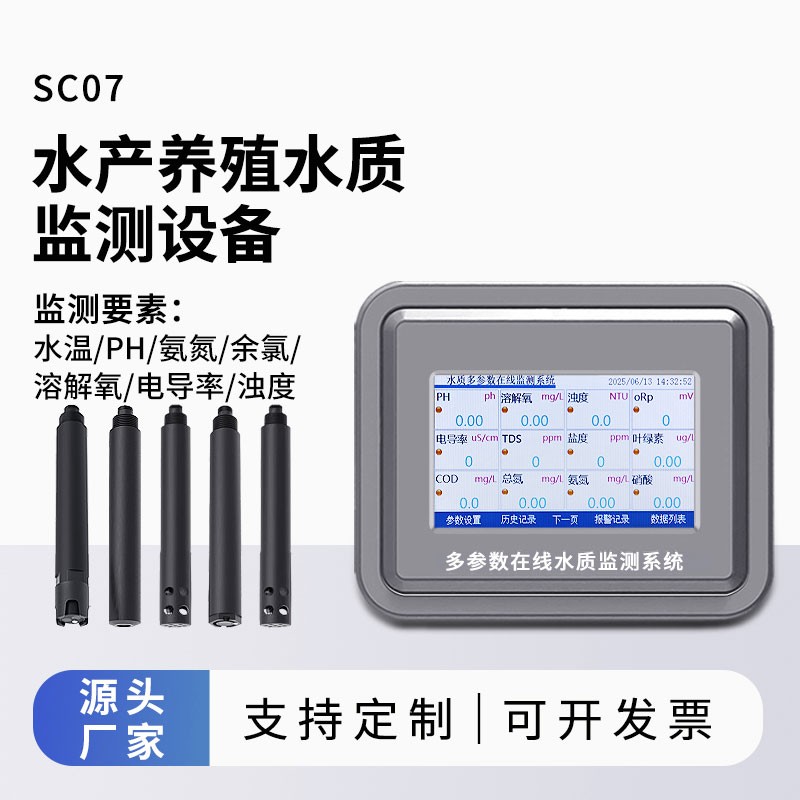
The water quality monitoring system for crab farming enables the online tracking of parameters such as water temperature, pH, ammonia nitrogen, residual chlorine, dissolved oxygen, electrical conductivity, and turbidity. The system supports the addition of further sensors as needed, automatically stores monitoring and alarm data—which can also be exported—and utilizes an RS485 interface with the MODBUS-RTU protocol, ensuring compatibility with a wide range of industrial equipment for data transmission.
Designed for monitoring the aquatic environment in crab ponds, this system provides real-time data on key parameters—including water temperature, pH, ammonia nitrogen, residual chlorine, dissolved oxygen, electrical conductivity, and turbidity—offering a reliable data foundation for managing the crab farming environment. The system employs specialized sensor technologies for each parameter: ion-selective electrodes for residual chlorine and ammonia nitrogen; an electrochemical salt-bridge method for pH; contact-based electrodes for electrical conductivity; a fluorescence-lifetime method for dissolved oxygen; and a light-scattering method for turbidity. Each parameter features specific measurement ranges, accuracy levels, and resolutions, meeting the requirements for long-term, continuous monitoring in crab ponds.
The system’s modular design allows for the integration of various water quality sensors, enabling users to customize their sensor configuration based on pond size, the crabs' growth stage, and specific environmental conditions. The system continuously logs monitoring data, automatically saving historical records and alarm events; these data can be exported for review, allowing managers to analyze water quality trends and evaluate the entire farming cycle. Equipped with an RS485 interface and supporting the MODBUS-RTU communication protocol, the system can seamlessly connect to PLCs, DCS, SCADA/configuration software, and DTUs, ensuring stable data transmission and easy integration into existing automated control systems.
Crabs are highly sensitive to changes in their aquatic environment. Fluctuations in factors such as water temperature, dissolved oxygen, and ammonia nitrogen levels can directly impact their growth rate, while a deterioration in water quality can easily trigger diseases, leading to losses in production. With a water quality monitoring system for crab farming, farmers are no longer solely reliant on manual sampling or personal experience to assess water conditions. Instead, they can continuously track real-time water quality dynamics in their ponds. If parameters fall outside safe ranges, the system’s alarm alerts allow for timely interventions—such as adjusting water quality or increasing oxygen levels—to maintain a stable aquatic environment.
Designed for pond-based crab farming, this monitoring system continuously collects water quality data, enabling managers to optimize the farming environment and stabilize aquatic conditions. This helps reduce the incidence of disease, accelerates crab growth, and improves the quality of the final product. Ultimately, the system facilitates a transition from traditional, experience-based farming to a digital, precision-managed approach, thereby lowering operational risks and increasing overall profitability.
African swine fever laboratory diagnostics is equipped with two independent detection channels and a total of 16 reaction wells, enabling simultaneous processing of two samples for parallel testing. This device is used for the quantitative and rapid diagnosis of livestock diseases such as Afri...
With the acceleration of urbanization, dust pollution from construction sites has become increasingly severe. It not only impairs urban air quality but also poses a threat to residents' health. To efficiently monitor and control this issue, the Dust Detector system has been developed by leveragi...
Agricultural production is closely related to weather changes, and weather conditions play a decisive role in the growth, development, and final yield of crops. Torrential rains may trigger floods, submerge farmland, and damage crops. Droughts, on the other hand, can lead to insufficient soil moistu...
The electronic weather meter is a portable meteorological observation instrument that integrates the measurement of multiple weather parameters into a single unit. It is capable of simultaneously and accurately measuring factors such as wind speed, wind direction, average wind speed, temperatu...


 Skype
 whatsapp
 mail