Tianqiong Sensor IOT Technology Co., Ltd
Sales Manager:Ms. Emily Wang
Cel,Whatsapp,Wechat:+86 15898932201
Email:info@fengtutec.com
Add:No. 155 Optoelectronic Industry Accelerator, Gaoxin District, Weifang, Shandong, China


Sales Manager:Ms. Emily Wang
Cel,Whatsapp,Wechat:+86 15898932201
Email:info@fengtutec.com
Add:No. 155 Optoelectronic Industry Accelerator, Gaoxin District, Weifang, Shandong, China
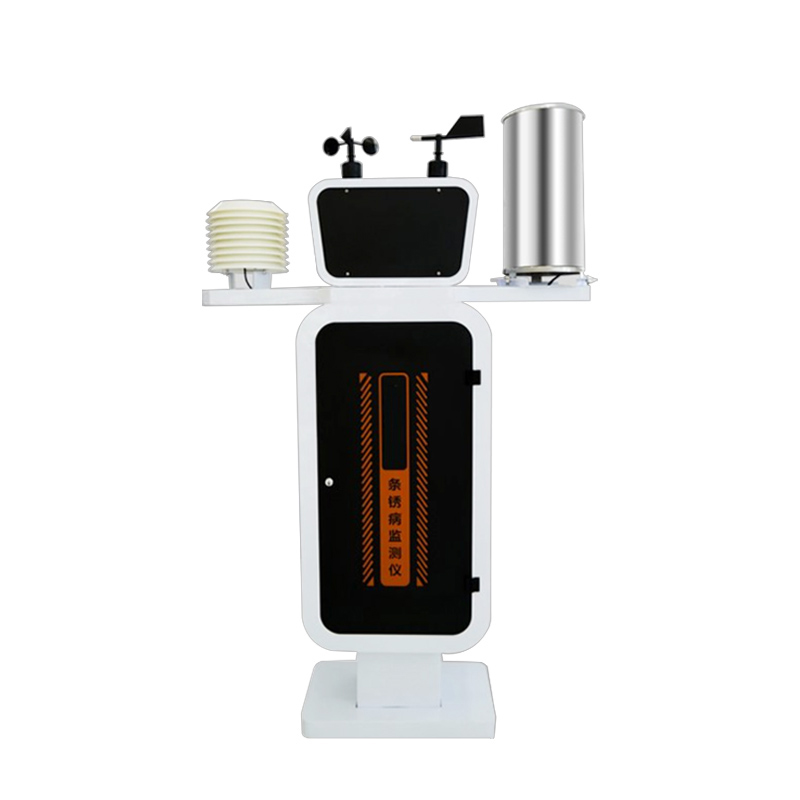
Model:FT-XM1
Brand:tianqiong
1.Product introduction of Wheat stripe rust monitoring instrument:
Wheat stripe rust monitoring instrument is a wheat stripe rust monitoring device that provides scientists and farmers with early warning of potential rust epidemics.The real-time monitoring and early warning device for crop diseases is an unattended meteorological acquisition system integrating meteorological data collection, storage, transmission and management.The Wheat stripe rust monitoring instrument conducts all-weather on-site monitoring of wind speed, wind direction, rainfall, air temperature, air humidity, atmospheric pressure and other factors.And wirelessly transmitted to the platform storage and analysis through 4G.The system can be used for automatic analysis and calculation through the built-in strip rust data model, which can be widely used in agricultural production.
2.Functional features of Wheat stripe rust monitoring instrument:
1.Collector: It adopts industrial-grade processing chip and is equipped with an ABS case.It is lightweight, sturdy and beautiful.7-inch LCD display screen, suitable for all kinds of harsh environments.
2.It has external USB disk storage expansion function.
3.Automatically analyze strip rust infection data, and automatically draw strip rust infection curves and microclimate environment data curves.
4.Prediction model: Corresponding prediction models can be established based on the growth characteristics and pathogen data of different crops to monitor and early warning of the occurrence trend of major crop diseases;
5.Disease data: With historical data backup and export functions, and can be displayed in diversified methods such as trend charts and bar charts.
6.Various viewing forms, supporting Web/App/WeChat official accounts and other methods to share stripe rust analysis data.
7.It has a GPS positioning module that can upload location information in real time.
8.Collect regularly and upload monitoring information automatically.
9.4G wireless transmission, interruption point transmission continues.
10.Solar power supply system.Extra long battery life.
3.Wheat stripe rust monitoring instrument sensor parameters
1.Air temperature: -30~70℃, accuracy: ±0.3℃
2.Air humidity: 0~100%, accuracy: ±3%
3.Wind speed: 0~45m/s, accuracy: ±1m/s
4.Wind direction: 0-360° Accuracy: ±1°
5.Rainfall: 0~50mm/hour, error: ±4%
6.Atmospheric pressure: 50-110Kpa, accuracy: 15 digits
Based on IoT technology, Monitor water quality integrates flow stabilization and venting, analysis and testing, system control, and remote communication units. It monitors indicators such as pH, temperature, turbidity, conductivity, dissolved oxygen, COD, ammonia nitrogen, and suspended solids...
In traditional cognition, agricultural production has often "relied on the weather", and weather changes have a huge impact on crop growth. Especially during the Sanfu days (the peak summer heat period), extreme weather such as high temperatures, high humidity, and heavy rainfall occurs fr...
The weather stations used in the agricultural field are called Agricultural Weather Stations. In order to better serve agricultural production, in addition to the conventional meteorological elements, Agricultural Weather Stations will also focus on increasing the monitoring of soil-related elements...
With the acceleration of urbanization, dust pollution from construction sites has become increasingly severe. It not only impairs urban air quality but also poses a threat to residents' health. To efficiently monitor and control this issue, the Dust Detector system has been developed by leveragi...


 Get a Free Quote

 Skype
Skype
 whatsapp
 mail
mail