Tianqiong Sensor IOT Technology Co., Ltd
Sales Manager:Ms. Emily Wang
Cel,Whatsapp,Wechat:+86 15898932201
Email:info@fengtutec.com
Add:No. 155 Optoelectronic Industry Accelerator, Gaoxin District, Weifang, Shandong, China


Sales Manager:Ms. Emily Wang
Cel,Whatsapp,Wechat:+86 15898932201
Email:info@fengtutec.com
Add:No. 155 Optoelectronic Industry Accelerator, Gaoxin District, Weifang, Shandong, China
time:2026-02-04 11:18:20 source:Weather Station viewed:414 time
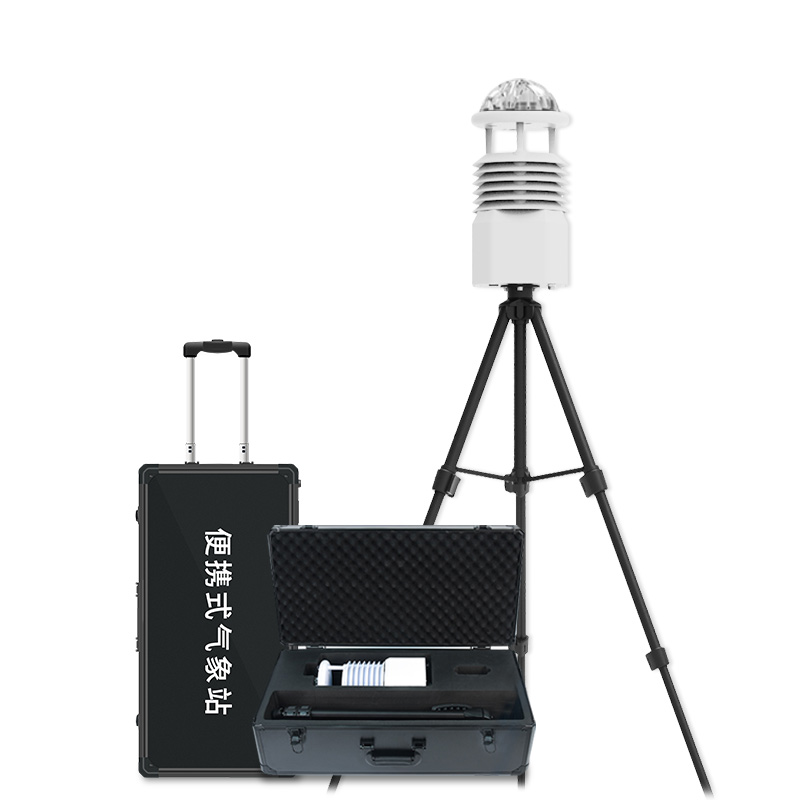
Mobile weather station is a highly integrated, low-power automatic weather observation device. It can monitor key meteorological elements such as wind speed, wind direction, temperature, humidity, atmospheric pressure, and optical rainfall in real time. It supports rapid installation and mobile use, making it suitable for emergency meteorological response and short-term field observations.
Mobile weather station is a miniaturized, integrated meteorological observation device that integrates multiple sensors and data acquisition and transmission units. Its core design goal is to meet users' needs for rapid acquisition, temporary deployment, or mobile monitoring of meteorological data at specific locations, overcoming the limitations of fixed weather stations that are immobile and have long construction cycles.
The device typically monitors six basic meteorological elements. Wind direction and speed are measured using ultrasonic principles, without mechanical rotating parts, resulting in low starting wind speed and rapid response. Temperature and humidity are measured using integrated digital sensors, and atmospheric pressure is obtained through a miniature barometer. Rainfall monitoring generally uses optical rain gauges, which estimate rainfall intensity and cumulative rainfall by analyzing the scattering of infrared light beams by raindrops.
High integration and low power consumption are its significant technical features. All sensors, data collectors, power supply units, and communication modules are integrated into a protective enclosure or a compact bracket, enabling plug-and-play operation. The low-power design, combined with a solar charging panel, ensures that the device can operate continuously for several days to weeks in off-grid field environments.
Rapid installation and deployment capabilities are its key advantages. The device is lightweight, and the bracket structure is simplified, allowing one person to complete setup and activation in just a few minutes. This portability enables rapid response to emergencies, such as establishing temporary weather observation points at disaster sites, during major events, or for scientific expeditions.
In practical applications, the device primarily serves two types of scenarios. First, emergency meteorological monitoring: when forest fires, geological disasters, chemical spills, or large-scale outdoor events occur, it can be quickly deployed to the target area to provide real-time wind direction, wind speed, temperature, humidity, and rainfall information, providing critical data support for decision-making. Second, mobile and short-term observation: for example, installed on mobile vehicles, temporary research stations, agricultural experimental fields, or engineering project sites, to obtain short-term, high-precision local meteorological data. Furthermore, the devices are generally equipped with wireless data transmission capabilities, allowing measurement data to be sent in real time to a cloud platform or user's mobile client via the network, enabling remote monitoring and data download. This greatly improves the timeliness and convenience of data acquisition.
Mobile weather station, with its integrated design, rapid deployment, and mobile observation capabilities, has become an important complement to fixed meteorological monitoring networks. It plays a vital role in meteorological emergency services, environmental protection, scientific research, and specific engineering projects, providing users with a flexible and reliable means of collecting meteorological data.
As a device widely used in fields such as water conservancy monitoring, environmental governance, and engineering construction, a flow meter can monitor water flow velocity data in real time with high accuracy, providing a scientific basis for decision-making. Currently, mainstream flow meters on th...
electronic weather station is a handheld multi-element meteorological observation device that simultaneously measures wind speed, wind direction, temperature, humidity, air pressure, altitude, thermal index, wet-bulb temperature, dew point, wind chill, wave height, and GNSS positioning. With b...
A cleanroom is a sealed space where parameters such as air cleanliness, temperature, humidity, and pressure are strictly controlled. It is widely used in industries with harsh environmental requirements, such as electronics, pharmaceuticals, healthcare, and biotechnology. Through special air purific...
Utilizing core technologies such as ultrasonic sensing, the portable mobile weather station features a convenient aluminum alloy handle, supports TF card storage and Bluetooth app communication, and can monitor multiple meteorological elements. It can also be mounted on a tripod for temporary...


 Skype
Skype
 whatsapp
 mail
mail