Tianqiong Sensor IOT Technology Co., Ltd
Sales Manager:Ms. Emily Wang
Cel,Whatsapp,Wechat:+86 15898932201
Email:info@fengtutec.com
Add:No. 155 Optoelectronic Industry Accelerator, Gaoxin District, Weifang, Shandong, China


Sales Manager:Ms. Emily Wang
Cel,Whatsapp,Wechat:+86 15898932201
Email:info@fengtutec.com
Add:No. 155 Optoelectronic Industry Accelerator, Gaoxin District, Weifang, Shandong, China
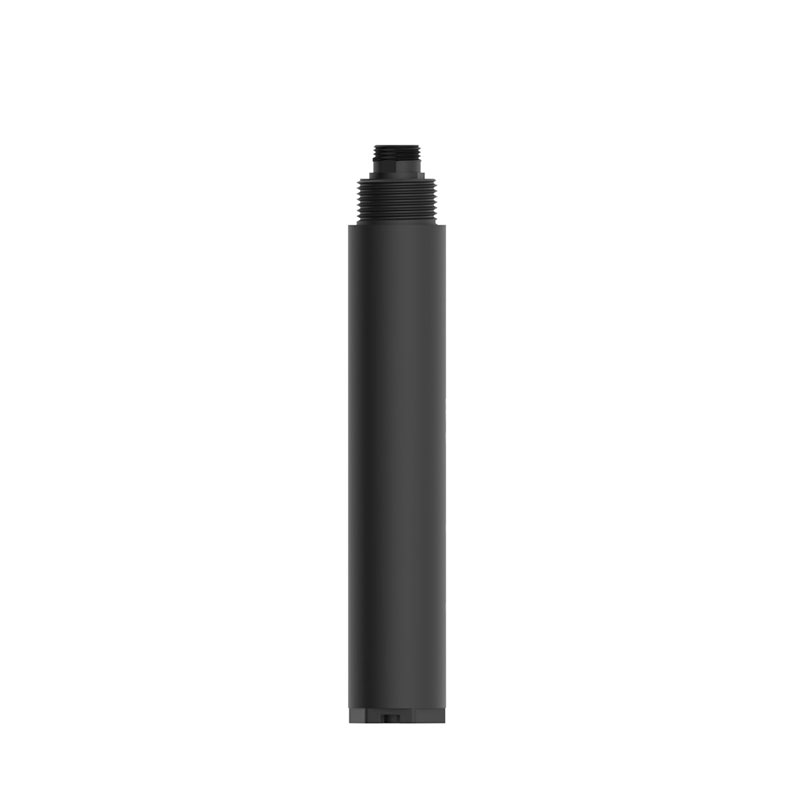
Model:FT-S9
Brand:tianqiong
one.How Online turbidity sensor works
Online Turbidity Sensor uses an advanced light scattering method to provide real-time, accurate turbidity measurements for municipal wastewater and industrial wastewater treatment.Online turbidity sensor determines the concentration of particles in the liquid by measuring the scattering of light.It uses a light source to shine into the liquid and then measures the intensity of the scattered light at different angles.This sensor uses 90° angle scattering method to linearly process the acquisition value, and outputs the turbidity value through a temperature compensation algorithm.
two.Online turbidity sensor technical parameters
| Measurement principle | Scattering light method |
| Range of measurement | 0~1000NTU (default) 0~40NTU, 0~3000NTU (customizable) |
| Resolution | 0.1NTU |
| Precision | ±1%, ±0.3℃ |
| Temperature compensation | Automatic temperature compensation |
| Output method | RS-485 (Modbus/RTU) |
| Storage temperature | -5-+65℃ |
| Work environment | 0~50℃,≤0.2MPa |
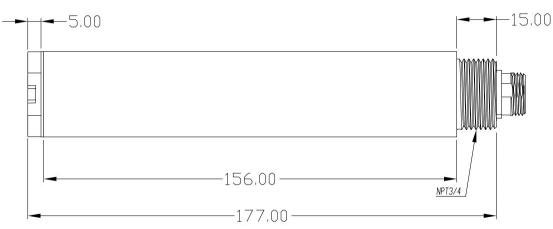
| Installation method | Immersive installation, 3/4NPT installation threads |
| Cable length | 5m |
| Power consumption | 0.2W,12V power supply |
| Power supply | DC: 12V-24V |
| Protection level | IP68 |
| Calibration method | Two-point calibration |
| Case material | ABS |
three.Online turbidity sensor size/installation
1.Online turbidity sensor size diagram
2.Wiring diagram
The cable is a 5-core shielded wire:
Red line - power line black line - ground line green line - 485A white line - 485B
3.Online turbidity sensor installation
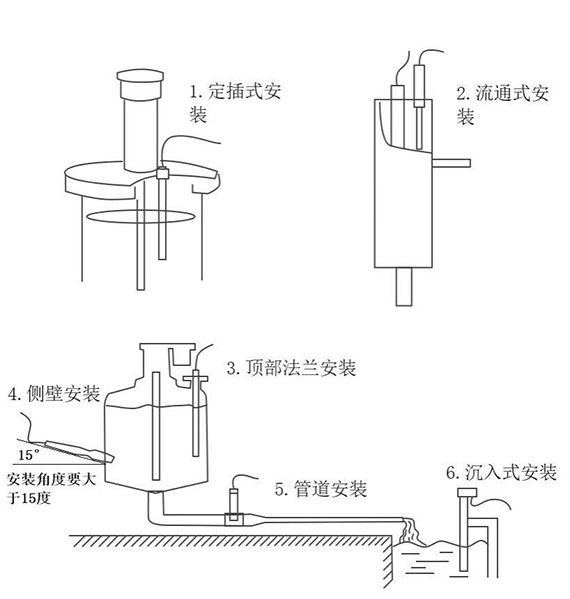
Note: The sensor cannot be installed inverted or horizontally when installed, and should be installed at least 15 degrees above the angle of inclination.The test port will not touch the container wall within 5CM left and right, and 10CM below
Four.Online turbidity sensor maintenance and maintenance
Sensor maintenance:
If the sensor needs to be cleaned, you can use warm water and an appropriate amount of detergent to clean it.
Notice:
Avoid strong vibration damage to the front of the transparent glass, and do not scratch with hard products.
five.Online turbidity sensor user calibration
The sensor has been carefully calibrated when it leaves the factory, and generally does not require user calibration.If the user calibration is performed, you can execute the instructions to restore the factory.
5.1 Zero Point Calibration
Place the sensor in a non-transparent container, and use distilled water or pure water to ensure that the sensor's test port will not touch the container wall within 5CM on the left and right, and 10CM below.After the value stabilizes for 30 seconds, perform zero-point calibration according to the communication instructions.
5.2 Slope calibration
Place the sensor in a non-transparent container, and use a solution with a known turbidity (the turbidity value must be greater than 20% range) to ensure that the sensor's test port will not touch the container wall within 5CM on the left and right, and 10CM below.After the value stabilizes for 30 seconds, the slope calibration will be performed according to the communication instructions.
The EL series of DC power supply is an important equipment in the testing link of the photovoltaic industry.It is specially used to provide power support for EL (Electroluminescence) testing of photovoltaic modules. In the production process of photovoltaic modules, EL testing is a key means to dete...
FT-NQ8 Meteorological Observation Station, specifically designed for agriculture, can accurately monitor 8 key elements. Each of these 8 elements is closely related to crop growth. Temperature is a key factor affecting the growth rate and physiological activities of crops. Different crops have speci...
In the photovoltaic field, "black heart" is a serious quality issue, manifested as the luminous intensity of some areas inside the photovoltaic module being significantly lower than the normal level, presenting black or dark areas. This indicates that the performance of the battery cells i...
Smart agriculture emerges from the deep integration of modern technology and agriculture. Through technologies like the Internet of Things, big data, and artificial intelligence, it achieves full-process information perception, intelligent decision-making, automatic control, and precise management i...


 Get a Free Quote
 Skype
Skype
 whatsapp
 mail
mail