Tianqiong Sensor IOT Technology Co., Ltd
Sales Manager:Ms. Emily Wang
Cel,Whatsapp,Wechat:+86 15898932201
Email:info@fengtutec.com
Add:No. 155 Optoelectronic Industry Accelerator, Gaoxin District, Weifang, Shandong, China


Sales Manager:Ms. Emily Wang
Cel,Whatsapp,Wechat:+86 15898932201
Email:info@fengtutec.com
Add:No. 155 Optoelectronic Industry Accelerator, Gaoxin District, Weifang, Shandong, China
time:2026-05-22 11:01:31 source:Weather Station viewed:216 time
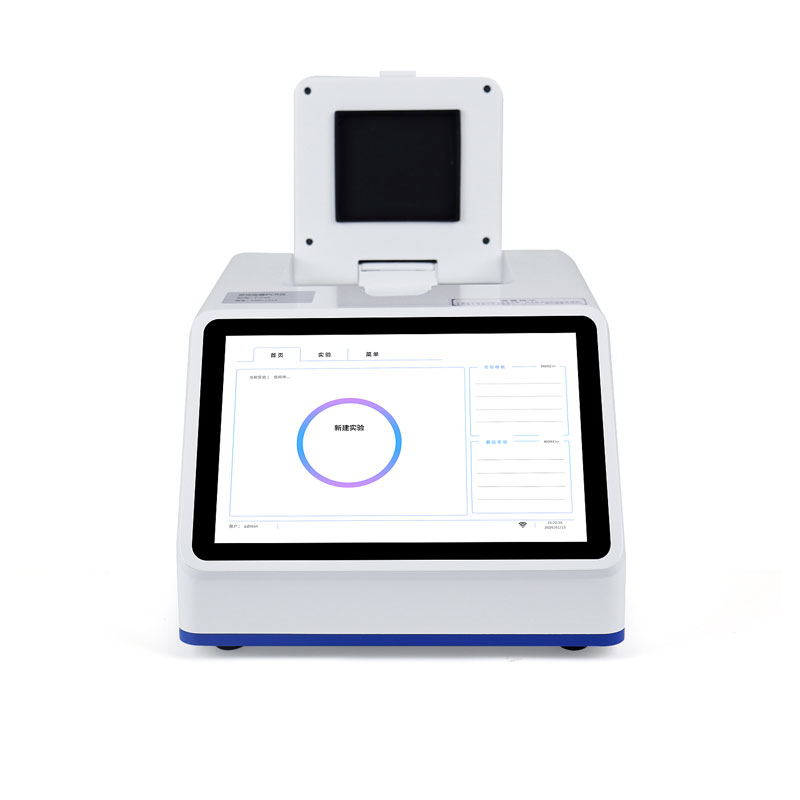
Fluorescent Quantitative PCR Detection System supports simultaneous four-color fluorescence detection and parallel analysis of 32 samples, suitable for pathogen detection, gene expression analysis, food safety monitoring, and disease control in aquaculture.
Fluorescent Quantitative PCR Detection System is a molecular detection device that combines real-time fluorescence monitoring with polymerase chain reaction (PCR) amplification technology. Its core configuration includes 32 reaction wells and four independent fluorescence detection channels, allowing for the simultaneous processing of up to 32 samples in a single experiment and simultaneous quantitative analysis of multiple target genes in each sample. Compared to conventional two-channel or single-channel devices, the four-channel design significantly improves multiplexing capabilities, allowing users to simultaneously detect internal reference genes and multiple target genes in a single reaction well, thereby saving reagent costs and reducing experimental errors.
Regarding temperature control, Fluorescent Quantitative PCR Detection System typically employs a semiconductor heating and cooling module, with a temperature control range covering 4℃ to 99℃, meeting the temperature requirements of routine PCR amplification, enzyme digestion, and reverse transcription. The heating and cooling rates generally exceed 4℃/second, effectively shortening the transition time of each cycle and controlling the entire amplification process within 90 minutes. Temperature uniformity is typically controlled within ±0.2℃, ensuring consistency in amplification efficiency across the 32 reaction wells, resulting in more reliable Ct values and quantitative results.
The optical detection system is another key technology of Fluorescent Quantitative PCR Detection System. Fluorescent Quantitative PCR Detection System uses LED light sources or halogen lamps with filter arrays, corresponding to mainstream fluorescent dyes such as FAM, VIC, ROX, and Cy5, respectively. After each cycle, the device scans each reaction well individually, acquiring fluorescence signals and generating amplification curves in real time. Detection sensitivity reaches the single-copy level, with a linear dynamic range covering the concentration range from 10 copies to 10^9 copies, accurately distinguishing subtle differences in threshold cycle numbers. Some models also feature passive reference dye correction, eliminating interference from pipetting errors and optical drift.
Fluorescent Quantitative PCR Detection System has applications covering multiple areas of scientific research and testing. In basic research, Fluorescent Quantitative PCR Detection System can be used for quantitative gene expression analysis, microRNA detection, and allele identification. In pathogen detection, the device can rapidly identify respiratory viruses, enteropathogenic bacteria, and bloodborne pathogens, providing molecular evidence for clinical auxiliary diagnosis. In food safety, the device can be used for the identification of animal-derived components in meat products, screening of genetically modified crop lines, and rapid screening for foodborne pathogens. In agriculture, forestry, and aquaculture, Fluorescent Quantitative PCR Detection System is used for early warning and epidemiological monitoring of diseases such as pine wilt nematode, African swine fever, avian influenza, and white spot syndrome in shrimp.
Operationally, most Fluorescent Quantitative PCR Detection System instruments are equipped with touchscreens and embedded operating systems, allowing users to complete program settings, operation control, and result viewing locally. The instrument supports various quantitative analysis methods, including absolute quantification, relative quantification, melting curve analysis, and endpoint fluorescence detection. Data export formats are compatible with common spreadsheets and text files, facilitating subsequent statistical analysis and report generation. Some devices also have built-in pre-set program libraries, allowing users to directly call standard amplification programs for common pathogen detection, reducing method development time.
In practical use, the 32-well throughput of Fluorescent Quantitative PCR Detection System falls between that of small portable models (8-well or 16-well) and large 96-well models, making it suitable for scenarios with moderate sample sizes but requiring rapid results. Mobile laboratories, grassroots quarantine stations, small research laboratories, and animal disease monitoring points are typical users of this equipment. Its compact size allows for flexible placement in biosafety cabinets or rapid testing kits, while its four-channel multi-detection capability is sufficient to meet the needs of most routine testing items. For daily operation and maintenance, the equipment typically employs a long-lasting LED light source and a calibration-free optical design, reducing the frequency of consumable replacements and the technical skill required for operation.
Based on IoT technology, Monitor water quality integrates flow stabilization and venting, analysis and testing, system control, and remote communication units. It monitors indicators such as pH, temperature, turbidity, conductivity, dissolved oxygen, COD, ammonia nitrogen, and suspended solids...
Integrated Weather Station is an integrated, high-precision outdoor monitoring device equipped with an all-in-one sensor capable of measuring ten parameters. It supports multiple data transmission methods, offers low power consumption, is easy to install, portable, and durable, making it suitable fo...
This high-precision handheld 11-element weather station integrates wind speed, wind direction, temperature, humidity, atmospheric pressure, altitude, thermal index, wet-bulb temperature, wave height, and GNSS tri-mode positioning. It is portable, easy to operate, and suitable for various field...
The Handheld Weather Station is a portable meteorological observation instrument that integrates multiple meteorological element monitoring functions, and the FT-SQ5A is a typical representative of it. It uses precise sensors and intelligent chips, and can accurately measure five meteorological elem...


 Skype
Skype
 whatsapp
 mail
mail