Tianqiong Sensor IOT Technology Co., Ltd
Sales Manager:Ms. Emily Wang
Cel,Whatsapp,Wechat:+86 15898932201
Email:info@fengtutec.com
Add:No. 155 Optoelectronic Industry Accelerator, Gaoxin District, Weifang, Shandong, China


Sales Manager:Ms. Emily Wang
Cel,Whatsapp,Wechat:+86 15898932201
Email:info@fengtutec.com
Add:No. 155 Optoelectronic Industry Accelerator, Gaoxin District, Weifang, Shandong, China
time:2025-10-30 08:54:45 source:Weather Station viewed:638 time
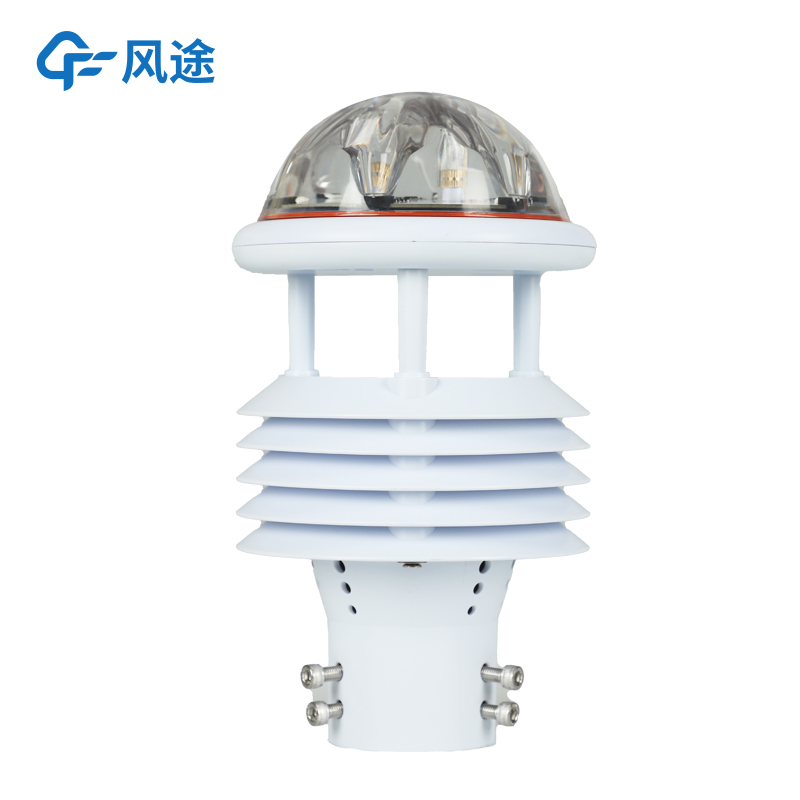
The FT-WQX6 micro weather sensor is a highly integrated device that combines multiple meteorological parameter measurement functions. Its key feature is the integration of six basic meteorological parameters—ambient temperature, relative humidity, wind speed, wind direction, atmospheric pressure, and optical rainfall—into a compact unified structure.
1. Six Basic Meteorological Elements
Wind speed and direction measurements adopt ultrasonic technology. By emitting continuously frequency-modulated ultrasonic signals and measuring relative phases to calculate results, this method has no moving parts, requires no minimum wind speed for activation, and enables real-time measurements. Air temperature adopts the diode junction voltage method for measurement, while air humidity is detected through capacitive principles. Atmospheric pressure is monitored by a piezoresistive sensor, and rainfall measurement adopts optical rainfall sensing technology.
2. Integrated Design Advantages
The "all-in-one" design is the device's highlight feature. This highly integrated structure combines sensors for all six parameters into one unit, providing multiple advantages:
Reduces external connection points and potential failure sources, enhancing overall reliability and durability during operation in harsh outdoor environments.
Ensures synchronization and consistency in data collection for all meteorological parameters, avoiding data deviations and time differences that may occur with discrete sensors, thus providing higher-quality data foundation for meteorological analysis and decision-making.
Greatly simplifies installation, disassembly, and maintenance processes, achieving maintenance-free operation and eliminating the need for on-site calibration.
3. Main Configuration Highlights
Concealed Ultrasonic Probe Design: The device adopts a top-mounted hidden ultrasonic probe design that effectively prevents measurement interference caused by snow/rain accumulation and natural wind obstruction.
Multiple Communication Interfaces: Standard RS485 communication interface complying with MODBUS protocol, while providing various optional interfaces such as RS232, USB, and Ethernet to support real-time data reading.
Secure Probe Attachment: The probe adopts a snap-on design that effectively prevents measurement errors caused by loosening during transportation and installation.
Durable Housing: The device housing adopts ASA engineering plastic, which possesses UV resistance, weathering resistance, and corrosion resistance properties, ensuring stable long-term outdoor operation.
Stability Protection: It also integrates a watchdog circuit and automatic reset function to further guarantee stable system operation.
In summary, the FT-WQX6 micro weather sensor is a practical meteorological sensor suitable for supporting automatic weather stations.
The UAV visibility meter is designed with full consideration of the requirements for UAV mounting. It features a lightweight and compact design, enabling it to be easily adapted to various small UAV platforms and reducing the burden on the UAV during flight. At the same time, the flat body design ca...
Negative oxygen ions are negatively charged particles formed when oxygen molecules combine with free electrons through natural processes. Known as the "air freshening factor", they not only purify the air but also regulate human health. They can adsorb dust and odor molecules, and improve...
Traditional visibility monitoring mainly relies on ground-based fixed stations. While these stations can provide continuous data, they have limitations such as limited spatial coverage, high construction costs, and difficulty in mobility. Especially in complex terrain areas (such as mountainous regi...
An Automatic Weather Station is a field meteorological device that can automatically observe, store, and transmit meteorological elements. It realizes the entire process automation from data collection to transmission, and is widely used in meteorological forecasting, agriculture, environmental prot...


 Skype
Skype
 whatsapp
 mail
mail