Tianqiong Sensor IOT Technology Co., Ltd
Sales Manager:Ms. Emily Wang
Cel,Whatsapp,Wechat:+86 15898932201
Email:info@fengtutec.com
Add:No. 155 Optoelectronic Industry Accelerator, Gaoxin District, Weifang, Shandong, China


Sales Manager:Ms. Emily Wang
Cel,Whatsapp,Wechat:+86 15898932201
Email:info@fengtutec.com
Add:No. 155 Optoelectronic Industry Accelerator, Gaoxin District, Weifang, Shandong, China
time:2025-12-19 11:01:46 source:Weather Station viewed:512 time
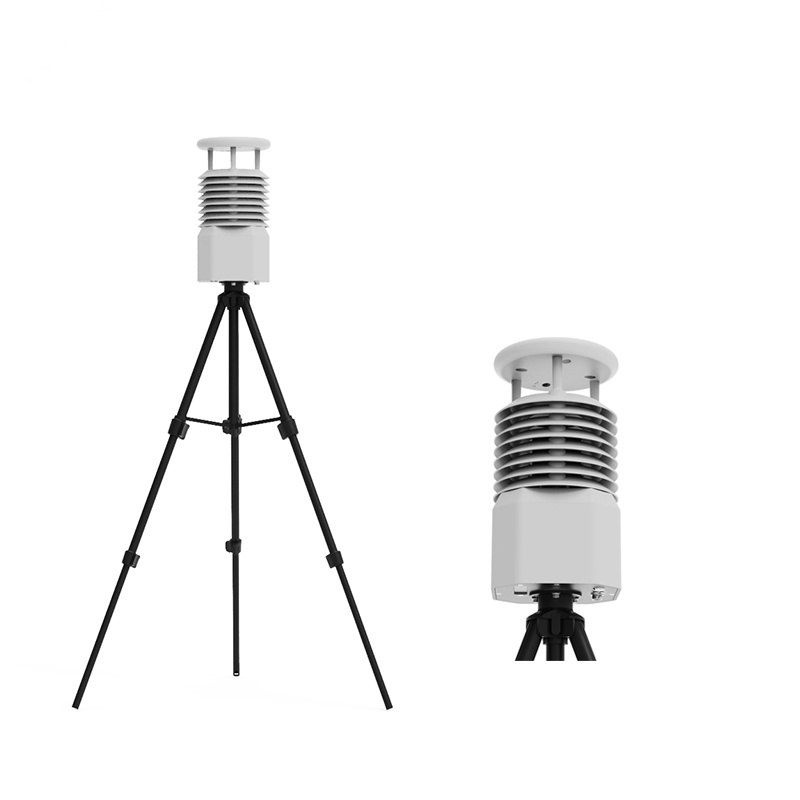
Home Weather Station is a portable environmental monitoring instrument used for on-site air quality monitoring. This device can measure multiple parameters in real time, including wind speed, wind direction, temperature, humidity, air pressure, PM2.5, PM10, and noise, providing an integrated on-site data acquisition solution for environmental assessment, industrial safety, and scientific research.
Home Weather Station is an integrated portable environmental monitoring device designed for rapid deployment in the field and simultaneous real-time measurement of various air quality and meteorological parameters. The parameters that this instrument can monitor typically include basic meteorological elements such as wind speed, wind direction, air temperature, relative humidity, and atmospheric pressure; core air quality parameters such as particulate matter concentration (PM2.5 and PM10); and environmental physical parameters such as noise levels.
For meteorological parameter monitoring, wind speed and direction data help analyze the direction and rate of pollutant diffusion. Temperature and humidity data not only reflect environmental comfort, but their combined analysis with particulate matter concentration can also assess the meteorological conditions for haze formation or dissipation. Atmospheric pressure data can be used for the calibration of certain sensor readings and is also fundamental information for meteorological analysis. These meteorological and air quality data are inherently correlated, and simultaneous collection provides a more comprehensive basis for pollution source tracing and trend analysis.
In air quality monitoring, the concentrations of PM2.5 (particulate matter with an aerodynamic diameter of 2.5 micrometers or less) and PM10 (particulate matter with an aerodynamic diameter of 10 micrometers or less) are key indicators for evaluating the level of ambient air pollution. Instruments typically use principles such as laser scattering for real-time measurement, directly displaying the mass concentration value. Noise monitoring is achieved through a built-in microphone and sound level meter circuit, measuring the equivalent sound level in the environment to assess noise pollution.
Portability is one of the core features of this device. The instrument has a compact overall design, a built-in rechargeable battery and data storage module, and comes with a carrying case for easy transport to different sites. The user interface is intuitive and supports real-time on-site readings. This design allows it to adapt to various temporary and mobile monitoring tasks that cannot be covered by fixed monitoring stations or require rapid emergency response, significantly improving the flexibility and coverage of environmental monitoring.
Home Weather Station has a wide range of practical applications. In the field of environmental supervision and assessment, environmental protection departments or third-party testing agencies use this equipment for on-site baseline investigations of environmental impact assessments for construction projects, environmental inspections around pollution sources, or emergency monitoring of sudden environmental incidents (such as dust and odor complaints). In industrial and occupational health settings, it can be used for monitoring fugitive emissions at factory boundaries, monitoring dust in mines or construction sites, and assessing noise and dust exposure levels in the work environment.
In urban management, this equipment can be used for short-term site studies of urban road traffic pollution distribution characteristics, or to monitor the acoustic environment and air quality in public places such as parks and squares. In scientific research, researchers can use it for field ecological observation, atmospheric chemistry research, or comprehensive surveys of microclimate and environmental quality in specific areas. Its integrated design avoids the inconvenience of carrying multiple single-function instruments, improving fieldwork efficiency and data spatiotemporal consistency.
The instrument's operation relies on an internally integrated multi-sensor module and central data processing unit. Analog or digital signals collected by each sensor are processed and recorded by the data acquisition unit and transmitted to a computer or mobile terminal via wired or wireless means. Users can set sampling frequencies, view real-time data curves, export historical records, and generate preliminary reports through the accompanying software. Regular calibration and maintenance of the sensors, especially particulate matter and noise sensors, are crucial to ensuring long-term data accuracy and reliability.
In summary, the Home Weather Station integrates monitoring functions for parameters such as wind speed, wind direction, temperature, humidity, air pressure, PM2.5, PM10, and noise into a single portable device, enabling rapid, multi-dimensional assessment of the on-site air environment. Its value lies in providing an efficient, flexible, and data-correlated on-site solution for environmental monitoring, industrial safety, urban management, and scientific research. This instrument fills the gap between fixed-site monitoring and laboratory analysis, making real-time, in-situ comprehensive environmental assessment possible, and is an important mobile monitoring tool in modern environmental management systems.
During ship navigation, when encountering waters with unknown water depth conditions, ship drivers face potential risks such as reef striking and stranding, which seriously threaten navigation safety. In such cases, a Portable Ultrasonic Water Depth Meter can be used.The Portable Ultrasonic Water De...
The working principle of Ground Penetrating Radar (GPR) is based on the propagation characteristics of electromagnetic waves. It emits high-frequency electromagnetic waves into the ground. When these waves propagate through underground media, once they encounter interfaces between different media—s...
Water Quality Monitoring Data Buoys can be fixed in water bodies for a long time, collecting real-time and continuous water quality data such as water temperature, pH value, dissolved oxygen, ammonia nitrogen, and turbidity. With the help of this real-time data, dynamic changes in water quality can...
In low-temperature and snowy weather, bridge icing is a serious problem. Bridge icing not only affects the stability of the bridge structure and shortens its service life, but also poses a great threat to the safety of passing vehicles and pedestrians, and is extremely likely to cause traffic accide...


 Skype
Skype
 whatsapp
 mail
mail