Tianqiong Sensor IOT Technology Co., Ltd
Sales Manager:Ms. Emily Wang
Cel,Whatsapp,Wechat:+86 15898932201
Email:info@fengtutec.com
Add:No. 155 Optoelectronic Industry Accelerator, Gaoxin District, Weifang, Shandong, China


Sales Manager:Ms. Emily Wang
Cel,Whatsapp,Wechat:+86 15898932201
Email:info@fengtutec.com
Add:No. 155 Optoelectronic Industry Accelerator, Gaoxin District, Weifang, Shandong, China
time:2026-08-27 10:35:36 source:Weather Station viewed:29 time
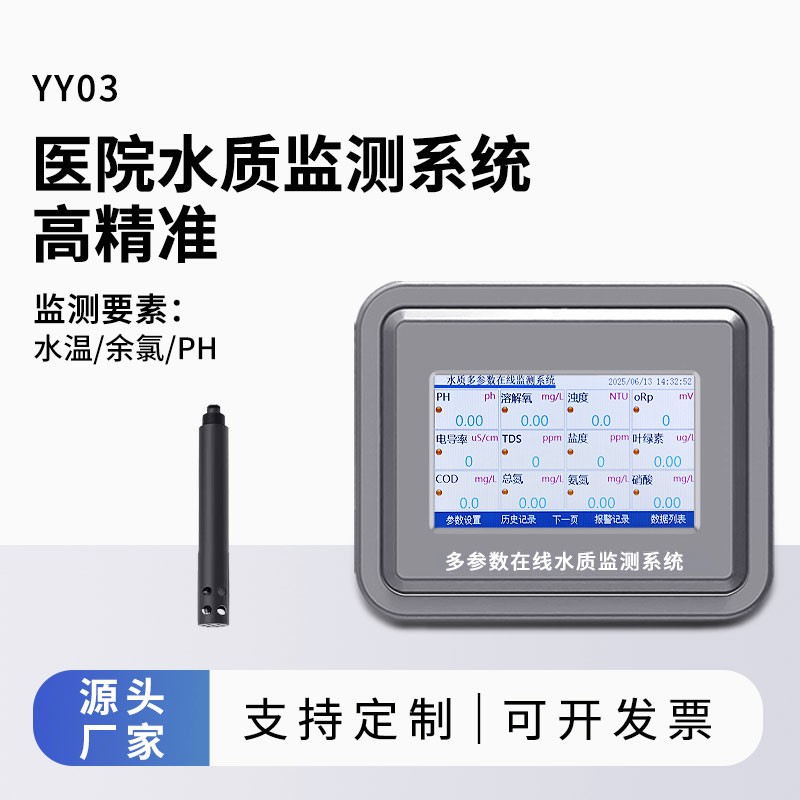
Hospital water quality monitoring can accurately monitor key parameters of water bodies online, such as residual chlorine, pH, and water temperature. It supports multi-sensor expansion configurations, retains and exports historical monitoring and alarm data, and connects to various devices using standard communication protocols, ensuring hospital water quality safety and compliance.
Hospital water quality monitoring is a core intelligent monitoring device for medical institutions to ensure the safety of medical water and regulate wastewater discharge. It is mainly used for routine monitoring of hospital medical wastewater and domestic sewage. By collecting and recording key water parameters in real time, it controls water quality safety from the source and avoids environmental and public health risks caused by substandard water quality.
The core monitoring indicators of Hospital water quality monitoring include residual chlorine, pH value, and water temperature. It adopts mature and stable detection principles. Residual chlorine is detected using the ion-selective electrode method, with a measurement range of 0~5.00 mg/L. pH is detected using an electrochemical salt bridge method, covering the full range of 0~14. The equipment boasts high detection accuracy, with residual chlorine detection error controlled within ±5% of the reading and pH value error not exceeding ±0.1 pH. Combined with high resolution of 0.01 mg/L and 0.01 pH, it can accurately capture subtle fluctuations in water quality, ensuring the accuracy and validity of monitoring data.
The system exhibits strong adaptability to various scenarios, supporting the expansion of multi-parameter water quality sensors. Hospitals can flexibly combine and configure monitoring modules according to different needs for water use and wastewater monitoring, adapting to multiple scenarios such as outpatient clinics, wards, and wastewater treatment plants. The system can automatically store long-term monitoring data and abnormal alarm records, supporting the query and export of historical data at any time, providing complete data support for hospital water quality control traceability and compliance verification.
Regarding the linkage and data transmission of the system, it is equipped with an RS485 interface, compatible with the MODBUS-RTU universal communication protocol, and can stably connect to various industrial and transmission equipment such as PLCs, DCSs, configuration software, and DTUs, enabling real-time uploading and remote transmission of monitoring data. The entire system is easy to operate and runs stably, requiring no frequent manual monitoring. It enables unmanned online monitoring around the clock, effectively improving the intelligence and precision of hospital water quality control. It is a key infrastructure for medical institutions to implement environmental compliance and safeguard water safety.
The Anemometer for Drones FT-F1 is specially designed for low-altitude wind measurement by unmanned aerial vehicles (UAVs). With high precision, stability, and efficiency, it provides accurate data for meteorological research, agricultural and forestry monitoring, environmental surveying, and other...
The online water quality monitoring system, based on IoT technology, consists of units such as flow stabilization and venting, analytical monitoring sensors, system control, and remote communication. It integrates sensors for residual chlorine, pH, water temperature, turbidity, and conductivit...
Climate change is leading to more frequent and intense extreme weather events (such as droughts, floods, heatwaves, and late spring cold snaps). These weather events cause devastating impacts on agricultural production. Traditional, experience-dependent farming models struggle to cope with this unce...
fluorescence quantitative PCR instrument is a four-channel 16-well quantitative PCR instrument running on an Android operating system. It has a temperature control range of 4℃ to 99℃ and a heated lid temperature of 30℃ to 108℃, making it suitable for molecular diagnostics, pathogen detecti...




 Skype
 whatsapp
 mail