Tianqiong Sensor IOT Technology Co., Ltd
Sales Manager:Ms. Emily Wang
Cel,Whatsapp,Wechat:+86 15898932201
Email:info@fengtutec.com
Add:No. 155 Optoelectronic Industry Accelerator, Gaoxin District, Weifang, Shandong, China


Sales Manager:Ms. Emily Wang
Cel,Whatsapp,Wechat:+86 15898932201
Email:info@fengtutec.com
Add:No. 155 Optoelectronic Industry Accelerator, Gaoxin District, Weifang, Shandong, China
time:2026-05-26 10:48:56 source:Weather Station viewed:233 time
Handheld Anemometer is a portable meteorological observation instrument. Its wind speed measurement range is 0–30 m/s with an accuracy of ±0.3 m/s and a resolution of 0.01 m/s. Wind direction measurement range is 16 azimuths with an accuracy of ±1 azimuth. The instrument uses a three-cup rotating frame structure to detect wind speed and a magnetic compass device to detect wind direction. It is equipped with an automatic north-finding device, eliminating the need for manual north alignment during measurement, making it suitable for mobile field observation.
Handheld Anemometer is a portable meteorological measuring instrument integrating microcomputer technology, widely used in meteorological observation, agricultural and forestry plant protection, environmental monitoring, construction, navigation and fisheries, and primary and secondary school education. The instrument measures wind speed through a three-cup rotating frame structure. When the wind flows through the cups, they rotate, and the rotation speed is proportional to the wind speed. The sensor converts the rotation speed into an electrical signal, which is then processed by a microcontroller to obtain the real-time wind speed value. The wind direction measurement uses a magnetic compass device, which determines the wind direction angle by sensing the direction of the Earth's magnetic field, and then converts it into a 16-directional display output. The instrument can simultaneously measure instantaneous wind speed and current wind direction, and operators can read the data with a single button press, without complex settings.
In terms of technical parameters, the wind speed measurement range is 0 to 30 meters per second, with a measurement accuracy of ±0.3 meters per second and a display resolution of 0.01 meters per second. The wind direction measurement uses a 16-directional division, with each direction corresponding to 22.5 degrees, a measurement accuracy of ±1 directional, and an initial wind speed not exceeding 0.8 meters per second. The instrument operates in environments ranging from -20℃ to 80℃ and can be used normally in harsh conditions such as rain, snow, high humidity, and sandstorms. The entire unit weighs approximately 0.5 kg, and the main unit measures 160 mm × 70 mm × 28 mm, making it easy to carry. The instrument is powered by three AA batteries, with an average current consumption of no more than 5 mA. It features an LCD screen for data display and triggers a low-voltage alarm when the battery voltage drops below 4.5 volts, reminding the user to replace the batteries.
The design prioritizes ease of use in the field. The wind direction measurement utilizes an automatic north-pointing device; the magnetic compass automatically calibrates north upon startup, eliminating the need for manual north alignment and preventing measurement errors caused by inaccurate direction. This makes it particularly suitable for non-professionals to use quickly in the field. The LCD screen features a custom panel, displaying measurement parameters and units directly in Chinese characters, such as "Wind Speed (m/s)" and "Wind Direction/Azimuth." The data display digits are 18 mm high, remaining clearly readable even in strong outdoor light or at considerable distances. The instrument has a built-in high-capacity FLASH memory chip, capable of storing up to 40,000 meteorological data points. The data recording interval can be set between 1 and 60 minutes. Users can export data to a USB flash drive or computer for further analysis via the USB communication interface. The entire unit is packaged in an aluminum alloy carrying case with internal cushioning material for easy transportation and long-term storage.
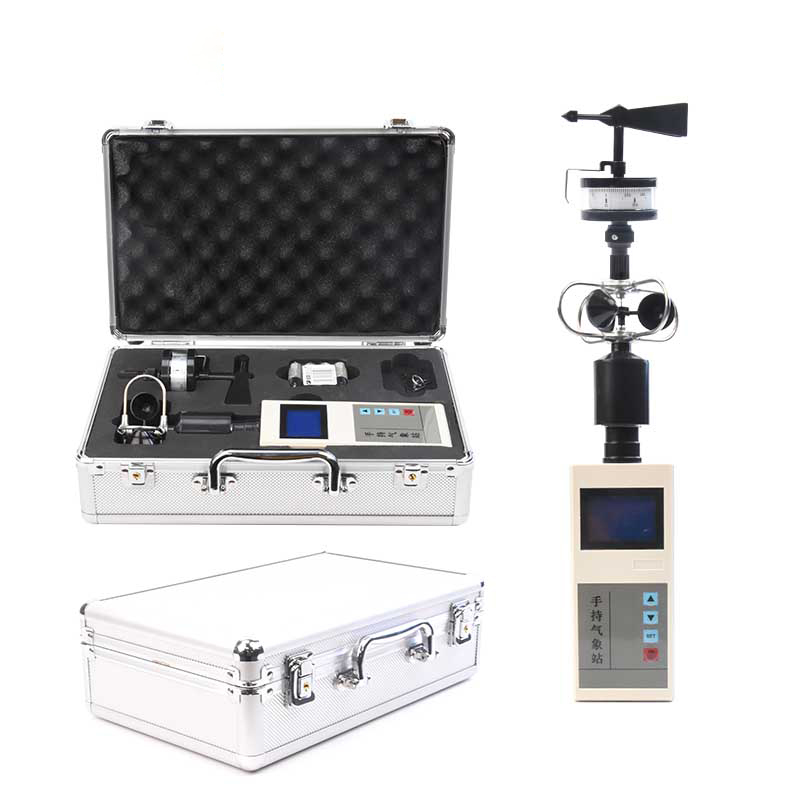
Portable Weather Station is a highly integrated, low-power, and rapidly deployable high-precision automatic meteorological observation device. It is suitable for various scenarios such as emergency short-term meteorological observation, mobile meteorological monitoring, and microclimate environment monitoring. It is primarily used for data acquisition in fields such as meteorology, agriculture and forestry, environmental protection, and emergency monitoring....
Ultrasonic weather station uses non-contact sensing technology to accurately monitor weather conditions and leverages 4G wireless transmission to provide borderless data services for smart agriculture....
African swine fever laboratory diagnostics is equipped with two independent detection channels and a total of 16 reaction wells, enabling simultaneous processing of two samples for parallel testing. This device is used for the quantitative and rapid diagnosis of livestock diseases such as Afri...
In the modern industrial field, the chemical industry has an extremely high demand for meteorological monitoring. The chemical production process is complex and involves many flammable, explosive, and corrosive chemical substances. For example, in a chemical industrial park, under different meteorol...


 Skype
Skype
 whatsapp
 mail
mail