Tianqiong Sensor IOT Technology Co., Ltd
Sales Manager:Ms. Emily Wang
Cel,Whatsapp,Wechat:+86 15898932201
Email:info@fengtutec.com
Add:No. 155 Optoelectronic Industry Accelerator, Gaoxin District, Weifang, Shandong, China


Sales Manager:Ms. Emily Wang
Cel,Whatsapp,Wechat:+86 15898932201
Email:info@fengtutec.com
Add:No. 155 Optoelectronic Industry Accelerator, Gaoxin District, Weifang, Shandong, China
time:2026-05-21 11:39:26 source:Weather Station viewed:208 time
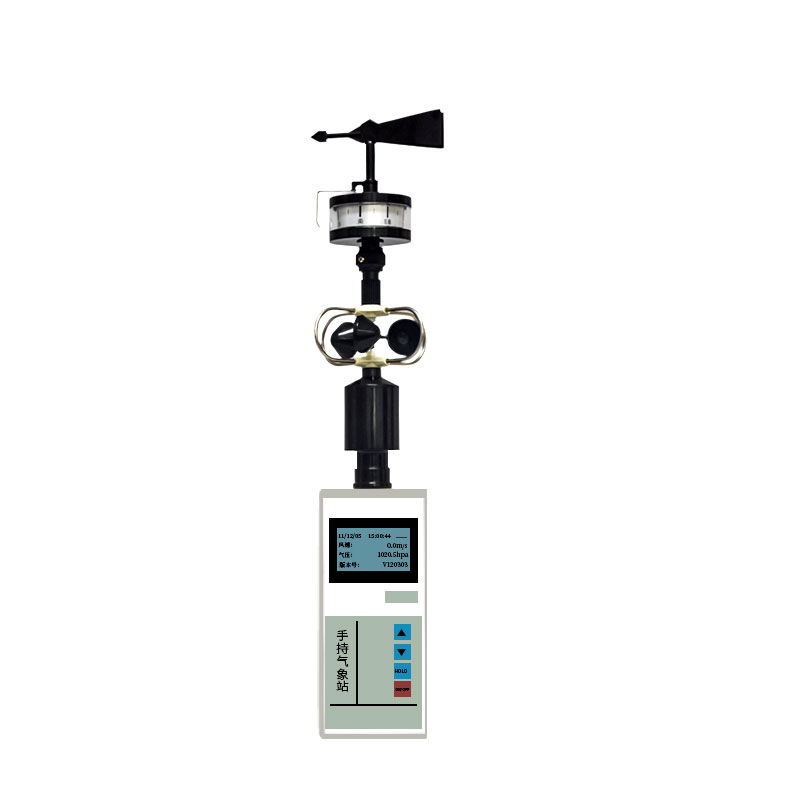
Handheld Weather meter is a portable and easy-to-operate mobile meteorological observation device that integrates the measurement functions of five meteorological elements: wind speed, wind direction, temperature, humidity, and atmospheric pressure. It uses precision sensors and intelligent chips, and has a built-in large-capacity FLASH memory chip that can store at least one year of meteorological data. It is widely used in meteorology, agriculture, forestry, environmental protection, scientific research, and outdoor activities.
Handheld Weather meter is a portable meteorological observation instrument that integrates multiple meteorological elements. The system uses precision sensors and intelligent chips to accurately measure five meteorological elements simultaneously: wind direction, wind speed, atmospheric pressure, temperature, and humidity. Some models can also measure extended elements such as average wind speed, altitude, thermal index, wet-bulb temperature, wave height, dew point temperature, and wind chill index. The device is handheld, allowing users to conduct meteorological observations anytime, anywhere. It can be widely used in meteorology, environmental protection, airports, agriculture and forestry, hydrology, military, warehousing, and scientific research.
In terms of technical performance, Handheld Weather meter has a wind speed measurement range of 0 to 60 meters per second, a wind direction measurement range of 0 to 360 degrees, a temperature measurement range of -40 to 125 degrees Celsius, a humidity measurement range of 0 to 100%RH, and an atmospheric pressure measurement range of 30 to 110 kPa. It features a built-in high-capacity FLASH memory chip capable of storing at least one year of meteorological data and is equipped with a Type-C communication interface for convenient data export and processing. The device has a built-in electronic compass, enabling 360-degree wind direction monitoring and supporting automatic and manual wind direction reading switching. Its low-power design allows the 3800 mAh lithium battery to operate continuously for approximately 18 hours.
Handheld Weather meter has a scientifically designed and portable structure. The main unit measures approximately 167 mm x 80 mm x 30 mm and weighs approximately 363 grams. The device is equipped with a 3.5-inch LCD screen that clearly displays all measurement data. In terms of data transmission, users can upload observation data to the cloud platform via an external DTU-4G module, and the 4G module can be plugged in and out to replace the IoT card at any time. A tripod can also be optionally installed, further expanding the application scenarios and measurement stability of the equipment. This device can effectively meet the real-time meteorological data acquisition needs in scenarios such as outdoor operations, agricultural inspections, and emergency monitoring.
A Lake Water Level Monitoring Station is a facility designed for the automated measurement of key parameters such as lake water level, flow velocity, flow rate, and water quality. Through continuous data collection and analysis, it provides a scientific basis for water resource management, flood war...
The Handheld Weather meter is extremely lightweight with an ergonomic design that can be held and operated with one hand. It can real-time monitor five core meteorological elements: wind speed, wind direction, temperature, humidity, and atmospheric pressure. Its rugged housing design can withstand c...
The portable weather station is an integrated, low-power, high-precision automatic observation device. It supports multiple transmission modes, can be quickly deployed, and can monitor twelve types of meteorological and environmental elements in real time. It is suitable for monitoring operati...
Pocket Weather Meter integrates sensors for wind speed and direction, temperature and humidity, atmospheric pressure, illumination, total radiation, ultraviolet radiation, and runway temperature, measuring multiple meteorological and road surface parameters in real time. The device employs ult...


 Skype
Skype
 whatsapp
 mail
mail