Tianqiong Sensor IOT Technology Co., Ltd
Sales Manager:Ms. Emily Wang
Cel,Whatsapp,Wechat:+86 15898932201
Email:info@fengtutec.com
Add:No. 155 Optoelectronic Industry Accelerator, Gaoxin District, Weifang, Shandong, China


Sales Manager:Ms. Emily Wang
Cel,Whatsapp,Wechat:+86 15898932201
Email:info@fengtutec.com
Add:No. 155 Optoelectronic Industry Accelerator, Gaoxin District, Weifang, Shandong, China
time:2026-02-25 11:03:45 source:Weather Station viewed:329 time
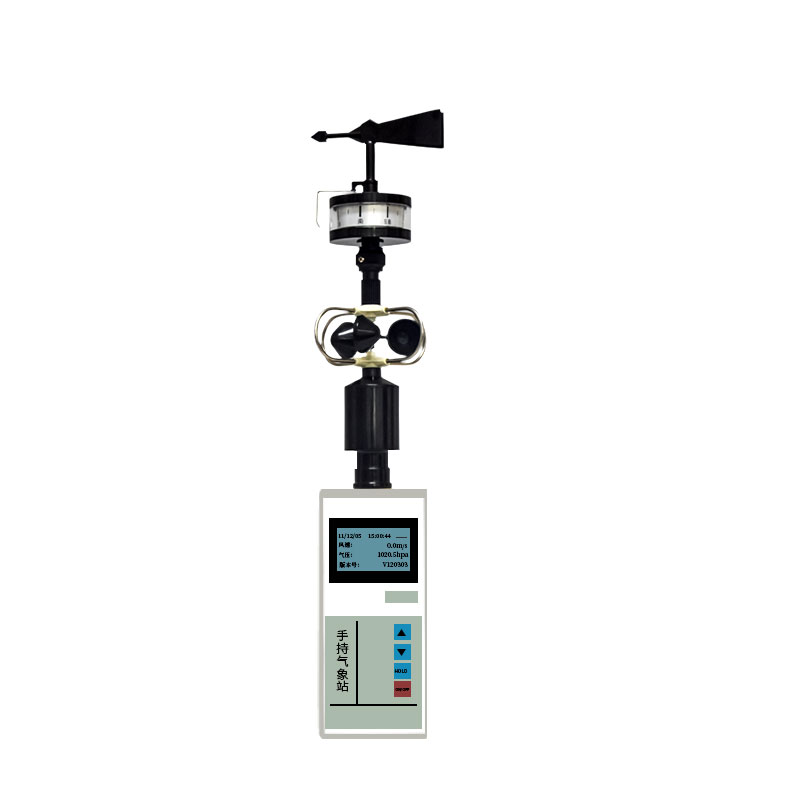
Handheld Weather Station is a portable observation device integrating multiple meteorological elements. It can simultaneously measure and display five parameters: wind direction, wind speed, atmospheric pressure, temperature, and humidity. It is suitable for meteorological monitoring, outdoor sports, agriculture, and environmental protection.
Handheld Weather Station is a mobile observation device that integrates multiple meteorological sensors into a small handheld terminal. Compared to traditional fixed weather stations, its core advantages lie in its portability and immediacy. Users can carry it to different locations and obtain comprehensive meteorological data of the current environment within seconds. These instruments typically adopt an integrated design, integrating wind speed and direction sensors, temperature and humidity probes, and air pressure sensors into a compact casing. A built-in display shows the measured values in real time. Some models support Bluetooth or wireless transmission, allowing data to be synchronized to mobile applications or cloud platforms.
Regarding the measured elements, Handheld Weather Station covers the core parameters of ground meteorological observation. Wind speed measurement uses impeller-type or ultrasonic sensors. The impeller-type anemometer calculates wind speed based on the rotational rate of the cups or propeller blades, with a starting wind speed as low as 0.3 m/s and a typical measurement range of 0 to 30 m/s or 0 to 40 m/s. Wind direction measurement uses an electronic compass combined with a wind vane to determine relative wind direction, outputting relative azimuth or the angle with true north. Atmospheric pressure measurement employs a MEMS silicon capacitive barometric pressure sensor with a range of 300 to 1100 hPa and an accuracy of ±0.5 to 1 hPa, meeting the needs of altitude conversion and weather trend assessment. Temperature and humidity measurements are integrated within a radiation shield. Temperature measurement typically uses platinum resistance or thermistor sensors with an accuracy of ±0.3 to 0.5 degrees Celsius, while humidity measurement uses a humidity-sensitive capacitive sensor with an accuracy of ±2 to 3% RH and a response time of less than 10 seconds.
The operation of Handheld Weather Station emphasizes rapid deployment and intuitive readings. The device automatically enters measurement mode upon power-on, requiring no calibration or complex settings. For wind speed measurement, impeller-type instruments require the wind cup to be pointed towards the airflow direction, while ultrasonic instruments have no directional requirements and can measure from any angle. The display typically uses an LCD or OLED panel, simultaneously displaying five parameters; some models are equipped with backlighting for nighttime use. A data hold function locks the current reading, and an averaging mode outputs the average wind speed over a period of time. Power is supplied by rechargeable lithium batteries or dry cell batteries, with battery life ranging from several days to several weeks depending on usage frequency. In terms of protection, civilian portable weather instruments typically achieve IP54 or IP67, providing protection against rain and short-term immersion.
Regarding application scenarios, Handheld Weather Station covers multiple fields including meteorological services, outdoor activities, agriculture, and environmental protection. In meteorological services, the equipment is used for emergency weather observation, disaster site environmental monitoring, and mobile inspections, filling gaps in fixed station coverage. In the outdoor sports field, mountaineers use it to assess summit wind speed and wind chill effects, campers monitor campsite temperature changes and precipitation trends, and sailors and fishermen obtain real-time information on wind conditions on lakes or nearshore areas. In agricultural planting, farmers can move between different plots to measure microclimate differences, assess frost risk and irrigation needs, and guide agricultural operations. In environmental monitoring, staff use it to measure wind fields at pollution diffusion sites and, combined with atmospheric stability, assess pollutant transport paths. In education and research, portable weather instruments serve as teaching tools, allowing students to intuitively understand the principles of meteorological element measurement.
In terms of data management and intelligence, modern weather instruments are gradually evolving towards the Internet of Things (IoT) and mobile internet. Some models have built-in Bluetooth modules, which, after pairing with a mobile application, can record measurement data in real time, generate change curves and statistical reports, and support historical data playback and export. GPS positioning automatically records the coordinates of measurement points, forming a spatial distribution map of meteorological data. Users can customize alarm thresholds, issuing alerts when measured values exceed the set range. Professional models support data comparison with fixed automatic weather stations, assisting in on-site calibration. With the development of sensor miniaturization technology, future handheld weather instruments are expected to integrate more elements, such as PM2.5 particulate matter concentration, light intensity, and ultraviolet index, further expanding mobile environmental monitoring capabilities.
Cellular Weather Station is a high-precision automatic meteorological observation device featuring an integrated 5-element sensor. It enables real-time observation of key meteorological parameters—including wind speed, wind direction, air temperature, humidity, and atmospheric pressure—and s...
A Lake Water Level Monitoring Station is a facility designed for the automated measurement of key parameters such as lake water level, flow velocity, flow rate, and water quality. Through continuous data collection and analysis, it provides a scientific basis for water resource management, flood war...
Soil moisture refers to the degree of dryness and wetness of the soil, and its value has a profound impact on the growth and development of crops. An appropriate soil moisture level can provide sufficient water for crops, ensuring the vigorous growth of plants and ultimately achieving a dual improve...
The Portable Weather Station is a lightweight monitoring device that integrates the functions of meteorological data observation, recording, and analysis. Its core positioning is to meet the meteorological monitoring needs in various mobile scenarios and emergency situations. With practicality and c...


 Skype
Skype
 whatsapp
 mail
mail